

Why Compliance Alone No Longer Protects Modern Enterprises?
For many organizations, compliance has become the foundation of cybersecurity strategy. Frameworks, certifications, and regulatory checklists are often treated as proof that the business is secure. While compliance plays an important role in governance and risk management, it does not automatically translate into real-world protection.
The problem is not compliance itself, the problem is over-reliance on compliance as the primary measure of security maturity.
Modern cyber threats evolve faster than most regulatory frameworks. Attackers do not target organizations based on whether they passed an audit. They target weaknesses in identity systems, cloud configurations, third-party access, employee behavior, and operational gaps that compliance programs may not fully address.
As enterprises accelerate digital transformation, the gap between being compliant and being resilient continues to grow.
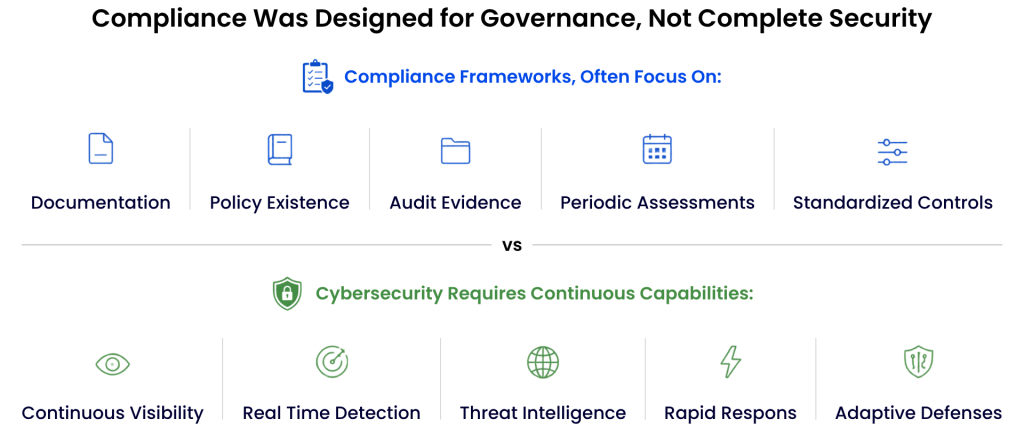
Compliance Was Designed for Governance, Not Complete Security
Compliance frameworks are created to establish minimum standards, improve accountability, and reduce common risks across industries. Regulations such as data privacy mandates, financial controls, and security certifications help organizations create baseline security practices.
However, compliance frameworks often focus on:
- Documentation
- Policy existence
- Audit evidence
- Periodic assessments
- Standardized controls
Cybersecurity, on the other hand, requires:
- Continuous visibility
- Real-time detection
- Threat intelligence
- Rapid response capabilities
- Adaptive defense strategies
A company can technically satisfy compliance requirements while still remaining vulnerable to ransomware, credential theft, cloud compromise, insider threats, or supply chain attacks.
Compliance confirms that controls exist.
Security determines whether those controls actually work under attack.
The False Sense of Security
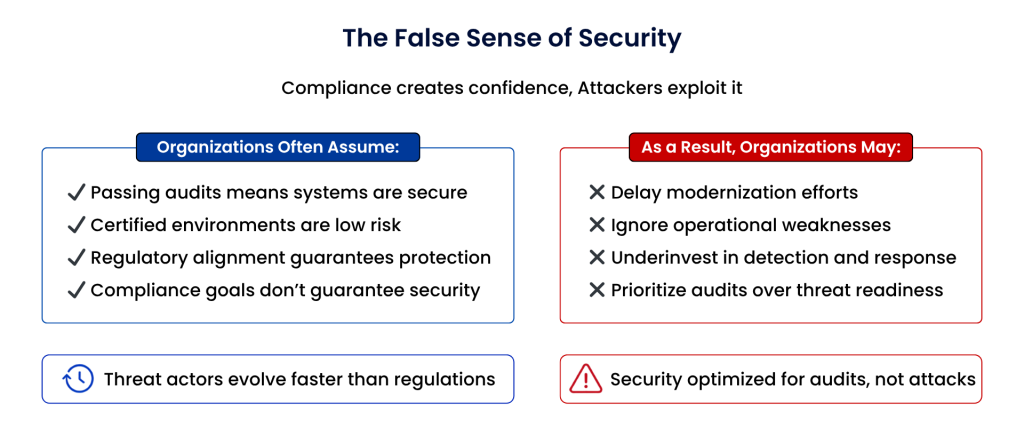
One of the biggest risks of compliance-driven security is the false confidence it creates within leadership teams.
Organizations often assume:
- Passing audits means systems are secure
- Certified environments are low risk
- Regulatory alignment guarantees protection
- Security investments are sufficient once compliance goals are achieved
This mindset can create dangerous blind spots.
Threat actors continuously adapt techniques faster than regulations evolve. Many compliance standards are updated slowly, while attack methods change weekly or even daily.
As a result, organizations may:
- Delay modernization efforts
- Ignore operational weaknesses
- Underinvest in detection and response
- Focus more on audit preparation than threat readiness
The outcome is a security posture optimized for passing assessments rather than surviving attacks.
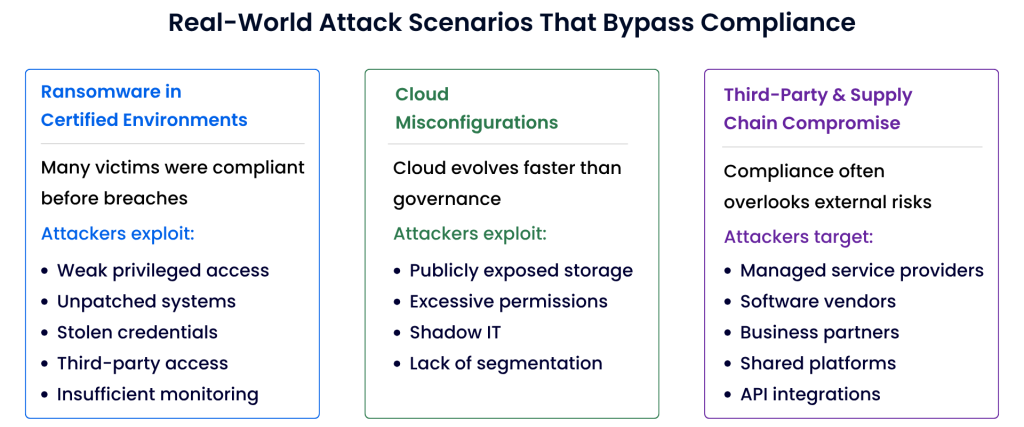
Real-World Attack Scenarios That Bypass Compliance
Ransomware in Certified Environments
Many ransomware victims had already achieved recognized compliance certifications before being breached. Attackers often exploit:
- Weak privileged access controls
- Unpatched systems
- Stolen credentials
- Third-party vendor access
- Insufficient monitoring
Even when required controls technically exist, poor implementation or lack of operational visibility creates exploitable gaps.
A compliant organization can still experience:
- Encrypted systems
- Operational shutdowns
- Supply chain disruption
- Data exfiltration
- Regulatory penalties after breach disclosure
Cloud Misconfigurations
Cloud environments evolve rapidly, often faster than governance processes can track.
Organizations may pass compliance reviews while:
- Storage buckets remain publicly exposed
- Excessive permissions exist across cloud identities
- Shadow IT expands unnoticed
- Sensitive workloads lack proper segmentation
Attackers actively scan for these weaknesses because they are common, easy to exploit, and often overlooked between audit cycles.
Third-Party and Supply Chain Compromise
Compliance programs frequently focus on internal controls while underestimating external ecosystem risk.
Attackers increasingly target:
- Managed service providers
- Software vendors
- Business partners
- Shared platforms
- API integrations
Even highly regulated organizations become vulnerable when trusted third parties are compromised.
Security resilience now depends not only on internal maturity, but also on visibility across interconnected ecosystems.
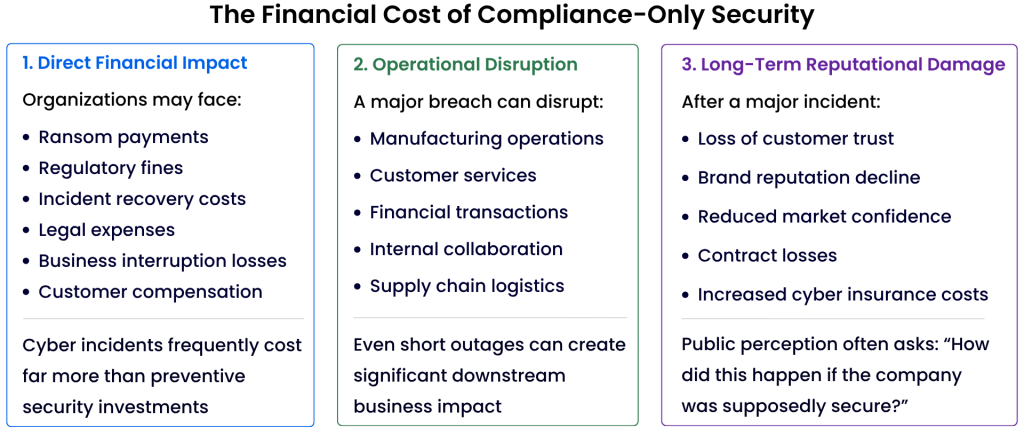
The Financial Cost of Compliance-Only Security
Over-relying on compliance creates both direct and indirect financial risks.
Direct Financial Impact
Organizations may face:
- Ransom payments
- Regulatory fines
- Incident recovery costs
- Legal expenses
- Business interruption losses
- Customer compensation
Cyber incidents frequently cost far more than preventive security investments.
Operational Disruption
A major breach can disrupt:
- Manufacturing operations
- Customer services
- Financial transactions
- Internal collaboration
- Supply chain logistics
In highly connected enterprises, even short outages can create significant downstream business impact.
Long-Term Reputational Damage
Customers, investors, and partners increasingly expect organizations to demonstrate operational resilience — not just regulatory compliance.
After a major incident, businesses may experience:
- Loss of customer trust
- Brand reputation decline
- Reduced market confidence
- Contract losses
- Increased cyber insurance costs
Public perception often focuses on one question:
“How did this happen if the company was supposedly secure?”
Compliance certifications rarely protect organizations from reputational fallout after a breach.
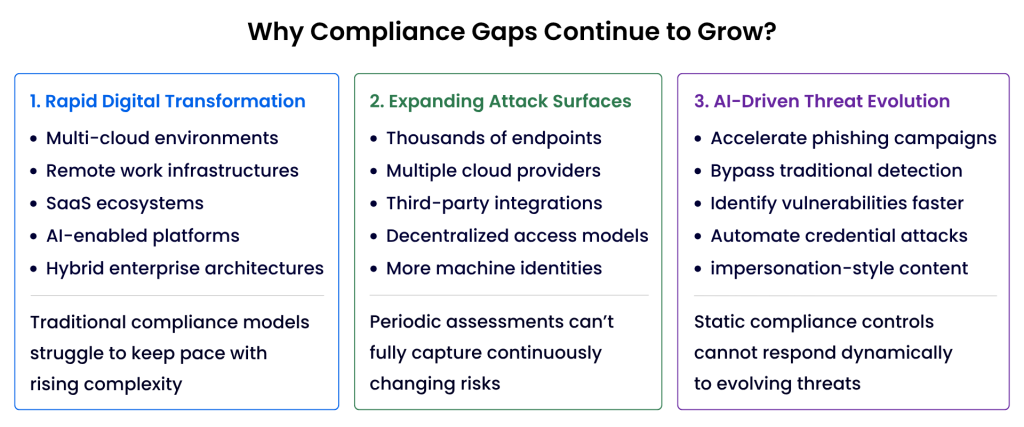
Why Compliance Gaps Continue to Grow?
Several modern business realities are widening the gap between compliance and effective cybersecurity.
Rapid Digital Transformation
Organizations now operate across:
- Multi-cloud environments
- Remote work infrastructures
- SaaS ecosystems
- AI-enabled platforms
- Hybrid enterprise architectures
Traditional compliance models struggle to keep pace with this level of technological complexity.
Expanding Attack Surfaces
Every connected system, API, device, partner, and identity expands the attack surface.
Security teams often manage:
- Thousands of endpoints
- Multiple cloud providers
- Third-party integrations
- Decentralized access models
- Large volumes of machine identities
Compliance assessments conducted periodically cannot fully capture continuously changing risk environments.
AI-Driven Threat Evolution
Attackers now leverage automation and AI to:
- Accelerate phishing campaigns
- Bypass traditional detection
- Identify vulnerabilities faster
- Automate credential attacks
- Generate convincing social engineering content
Static compliance controls cannot respond dynamically to evolving attack techniques.
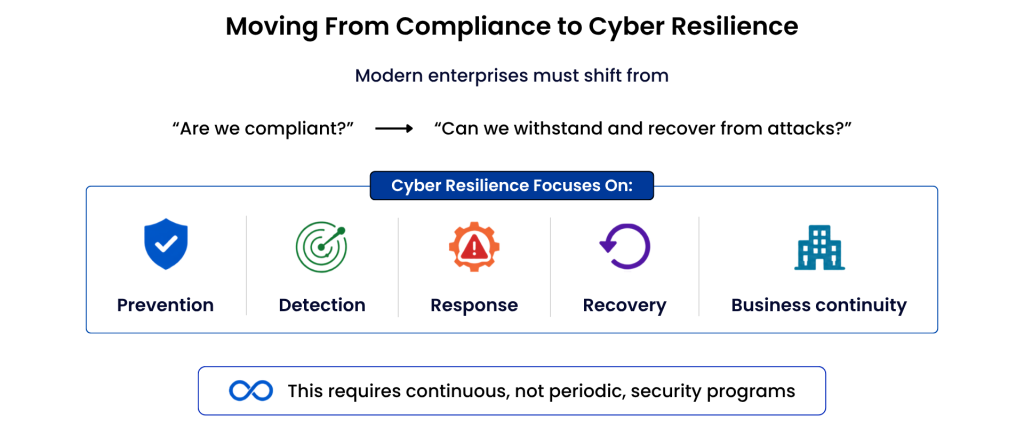
Moving From Compliance to Cyber Resilience
Modern enterprises must shift from “Are we compliant?” to “Can we withstand and recover from attacks?”
Cyber resilience focuses on:
- Prevention
- Detection
- Response
- Recovery
- Business continuity
This requires security programs that operate continuously rather than periodically.
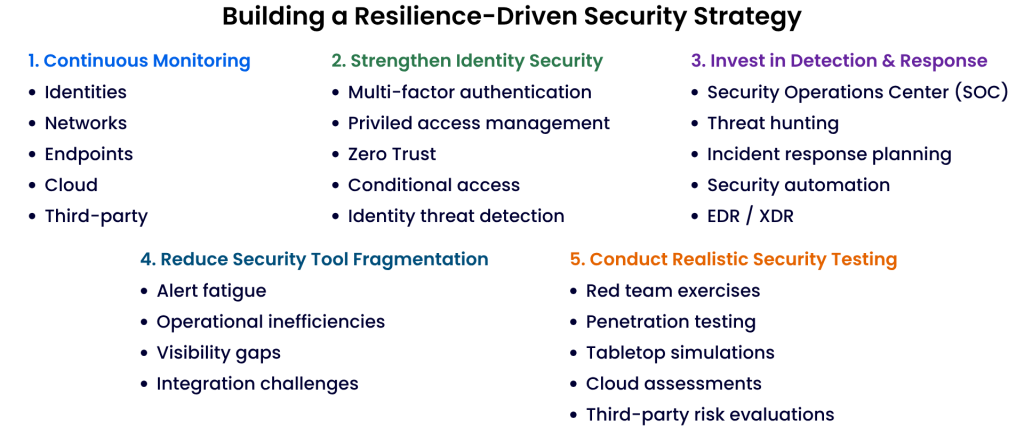
Building a Resilience-Driven Security Strategy
Prioritize Continuous Monitoring
Organizations need real-time visibility across:
- Identities
- Networks
- Endpoints
- Cloud environments
- Third-party connections
Continuous monitoring enables faster detection of suspicious behavior before incidents escalate.
Strengthen Identity Security
Identity has become the new security perimeter.
Critical priorities include:
- Multi-factor authentication
- Privileged access management
- Zero Trust principles
- Conditional access policies
- Identity threat detection
Compromised credentials remain one of the most common entry points for attackers.
Invest in Detection and Response
Security resilience depends heavily on operational capability.
Organizations should strengthen:
- Security Operations Centers (SOC)
- Threat hunting
- Incident response planning
- Security automation
- Endpoint detection and response (EDR)
- Extended detection and response (XDR)
The ability to rapidly contain attacks often determines the overall business impact.
Reduce Security Tool Fragmentation
Many enterprises accumulate excessive security tools that create:
- Alert fatigue
- Operational inefficiencies
- Visibility gaps
- Integration challenges
Simplified and integrated architectures improve both security effectiveness and operational efficiency.
Conduct Realistic Security Testing
Compliance audits alone are insufficient.
Organizations should regularly perform:
- Red team exercises
- Penetration testing
- Tabletop incident simulations
- Cloud security assessments
- Third-party risk evaluations
Testing reveals whether controls function effectively during real attack conditions.
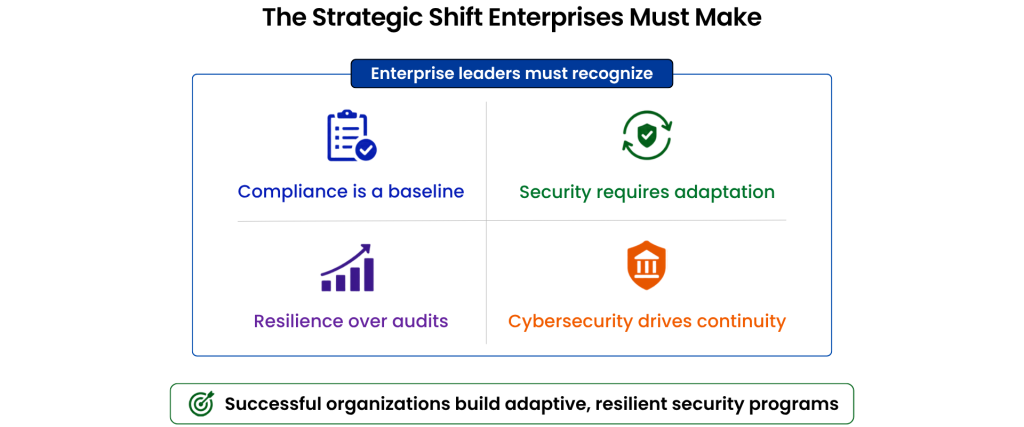
The Strategic Shift Enterprises Must Make
The future of cybersecurity is not compliance avoidance — it is resilience prioritization.
Compliance should remain an important component of governance and regulatory alignment. But it cannot serve as the primary measure of organizational security readiness.
Enterprise leaders must recognize:
- Compliance is a baseline, not a defense strategy
- Security maturity requires continuous adaptation
- Operational resilience matters more than audit success
- Cybersecurity is now a business continuity issue
The organizations that succeed in the coming years will be those that build security programs capable of adapting to evolving threats, minimizing disruption, and recovering quickly under pressure.
Conclusion
Compliance frameworks provide structure, accountability, and important baseline protections. But modern cyber threats expose the limitations of treating compliance as the ultimate security objective.
Attackers exploit operational weaknesses, not missing paperwork.
Organizations that focus only on meeting regulatory requirements risk creating environments that appear secure during audits but remain vulnerable in practice.
The strategic priority for modern enterprises is no longer simply achieving compliance — it is building resilient security ecosystems capable of preventing, detecting, responding to, and recovering from constantly evolving threats.