
Why Cyber Incident Readiness Is No Longer Optional?
Cyber incidents are no longer isolated events affecting only large enterprises or highly targeted industries. Every organization connected to digital infrastructure faces continuous exposure to ransomware, phishing campaigns, insider threats, supply chain compromises, and operational disruptions. The real differentiator today is not whether an incident will happen — it is how prepared an organization is when it does.
Many businesses still underestimate the true cost of cyber unpreparedness. They invest heavily in prevention technologies while neglecting response readiness, crisis coordination, recovery planning, and executive decision-making processes. Unfortunately, the financial and operational consequences of this gap become visible only after a serious incident occurs.
A poorly managed cyber incident can trigger extended downtime, significant revenue loss, reputational damage, regulatory scrutiny, customer attrition, and long-term business instability. In many cases, the largest losses are not caused by the attack itself, but by delayed response actions, unclear leadership responsibilities, and lack of operational preparedness.
Organizations that fail to prepare are not simply accepting technical risk — they are exposing the entire business to strategic, financial, and reputational consequences.
Understanding the Real Cost of Cyber Unpreparedness
Cyber incidents create cascading business impacts across operations, finance, communications, legal, and customer trust. The absence of an effective incident response capability amplifies every stage of the crisis.
1. Operational Downtime and Business Disruption
Downtime is often the most immediate and visible consequence of a cyber incident. When systems become unavailable due to ransomware, data corruption, or infrastructure compromise, business operations slow down or stop entirely.
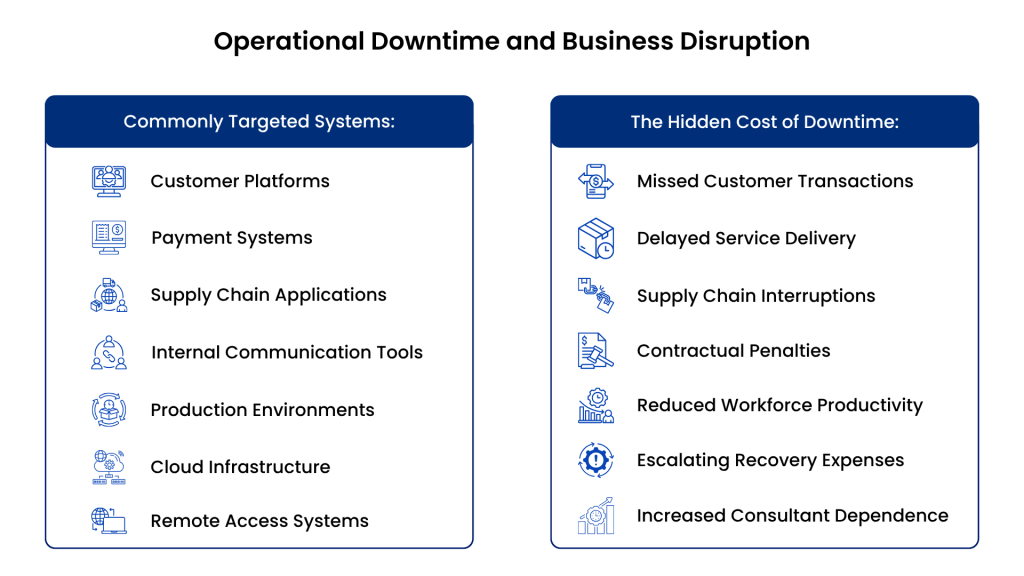
Critical systems commonly affected include:
- Customer platforms
- Payment systems
- Supply chain applications
- Internal communication tools
- Production environments
- Cloud infrastructure
- Remote access systems
For organizations operating in sectors such as healthcare, finance, manufacturing, logistics, and e-commerce, even a few hours of downtime can translate into severe operational disruption.
The Hidden Cost of Downtime
The impact of downtime extends far beyond temporary inconvenience.
It can result in:
- Missed customer transactions
- Delayed service delivery
- Supply chain interruptions
- Contractual penalties
- Reduced workforce productivity
- Escalating recovery expenses
- Increased dependency on external consultants
Organizations without tested response procedures often spend valuable hours determining:
- Who should lead the response
- Which systems are affected
- Whether backups are trustworthy
- How to communicate internally
- Which business functions must be prioritized
During a cyber crisis, uncertainty becomes expensive.
Revenue Loss and Financial Impact
The financial consequences of cyber incidents continue to increase globally. Revenue loss occurs both directly and indirectly, often extending months beyond the original event.
Direct Financial Losses
Immediate financial impacts may include:
- Incident containment costs
- Digital forensics expenses
- Legal consultations
- Regulatory penalties
- Recovery infrastructure investments
- Ransom payments
- Third-party remediation services
For organizations lacking preparedness, these costs escalate rapidly because response efforts become reactive rather than structured.
Indirect Financial Damage
Indirect losses are frequently more damaging over time.
These include:
- Customer churn
- Delayed business operations
- Reduced sales activity
- Contract cancellations
- Investor concerns
- Market valuation decline
- Increased cyber insurance premiums
When organizations cannot restore operations quickly, customers begin seeking more reliable alternatives. Partners and vendors may also reconsider relationships if they perceive elevated operational risk.
Cyber incidents therefore evolve from technical disruptions into long-term business continuity challenges.
Brand Damage and Loss of Customer Trust
Trust is one of the most valuable assets an organization possesses. A poorly handled cyber incident can erode years of brand credibility within days.
Reputation Is Built Slowly — Lost Quickly
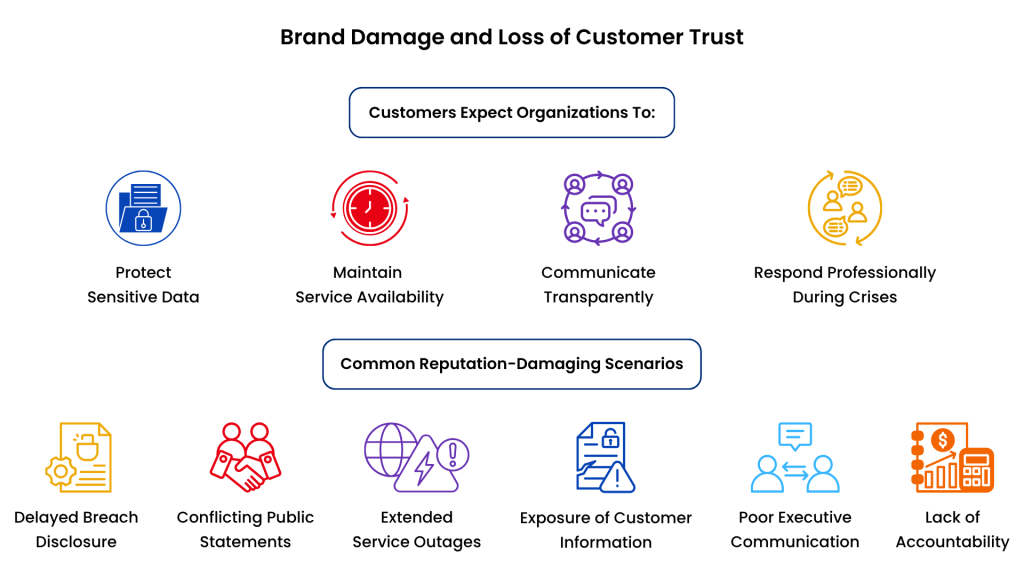
Customers expect organizations to:
- Protect sensitive data
- Maintain service availability
- Communicate transparently
- Respond professionally during crises
When organizations fail to meet these expectations, public confidence deteriorates rapidly.
Common reputation-damaging scenarios include:
- Delayed breach disclosure
- Conflicting public statements
- Extended service outages
- Exposure of customer information
- Poor executive communication
- Lack of accountability
In today’s digital environment, news spreads instantly through social media, news platforms, and industry communities. A single poorly managed incident can dominate public discussion and permanently influence customer perception.
Long-Term Brand Consequences
Brand damage is difficult to measure precisely because its effects are cumulative and long-lasting.
Consequences may include:
- Reduced customer loyalty
- Declining market credibility
- Lower acquisition rates
- Recruitment challenges
- Investor skepticism
- Competitive disadvantage
Organizations that recover operationally may still spend years rebuilding trust.
Decision-Making Delays During a Crisis
One of the most overlooked consequences of cyber unpreparedness is delayed decision-making.
Technical recovery is important, but executive coordination determines how effectively an organization navigates the broader crisis.
Why Delays Happen?
Organizations without established response frameworks often face confusion regarding:
- Incident ownership
- Escalation procedures
- Legal obligations
- Regulatory reporting timelines
- Public communication approvals
- Business continuity priorities
This leads to fragmented decision-making across departments.
Security teams may wait for executive approval.
Executives may wait for technical clarity.
Legal teams may delay communications.
Operations teams may lack recovery direction.
Meanwhile, attackers continue exploiting the disruption window.
The Cost of Slow Decisions
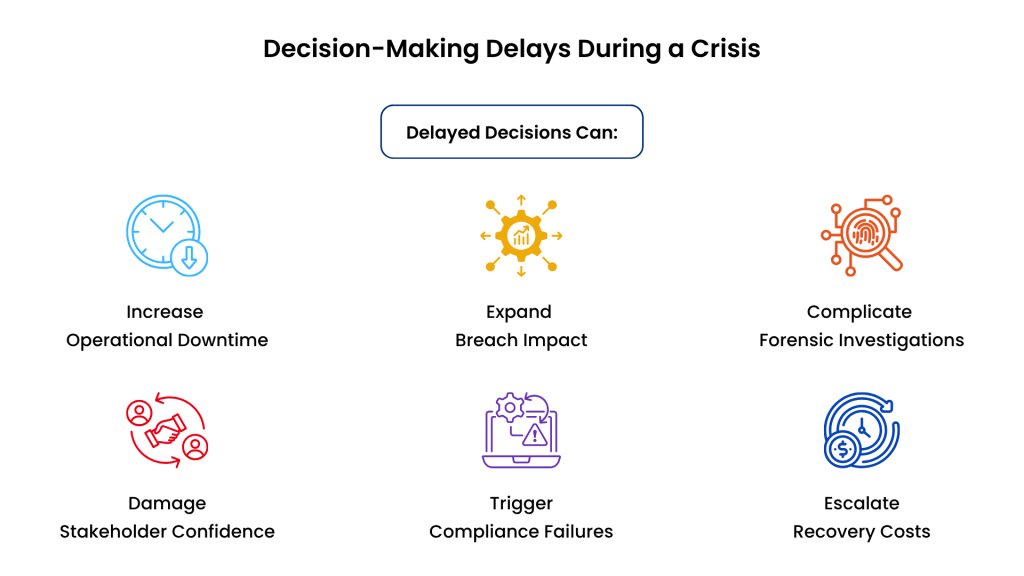
Delayed decisions can:
- Increase operational downtime
- Expand breach impact
- Complicate forensic investigations
- Damage stakeholder confidence
- Trigger compliance failures
- Escalate recovery costs
Organizations that respond effectively are typically those that have already practiced difficult decisions before a real incident occurs.
Preparedness reduces uncertainty.
Why Incident Response Readiness Matters?
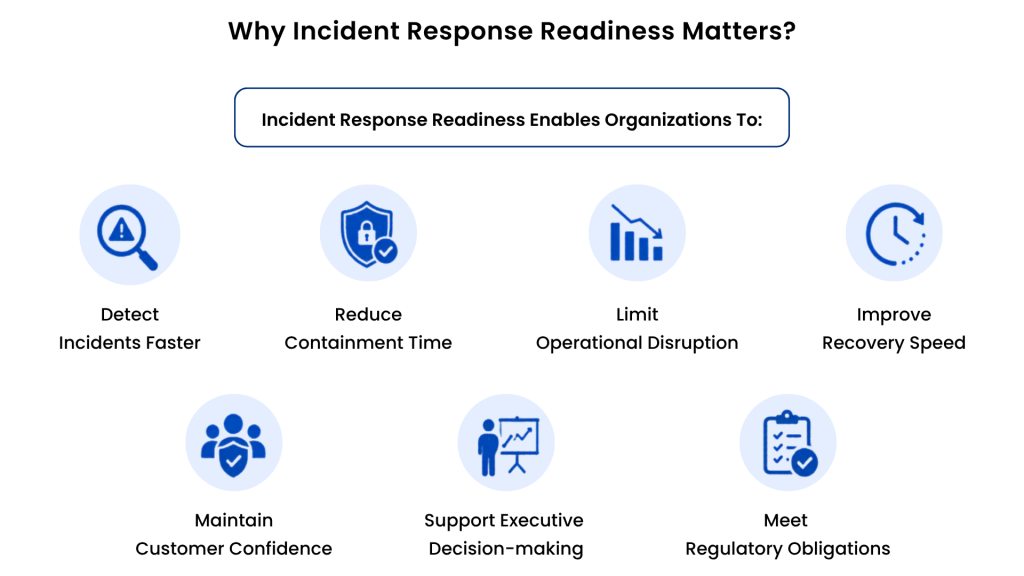
Cyber resilience is not achieved through technology alone. It requires preparation, coordination, leadership alignment, and continuous testing.
Incident response readiness enables organizations to:
- Detect incidents faster
- Reduce containment time
- Limit operational disruption
- Improve recovery speed
- Maintain customer confidence
- Support executive decision-making
- Meet regulatory obligations
Prepared organizations do not eliminate cyber risk entirely, but they significantly reduce business impact.
Key Components of Effective Response Readiness
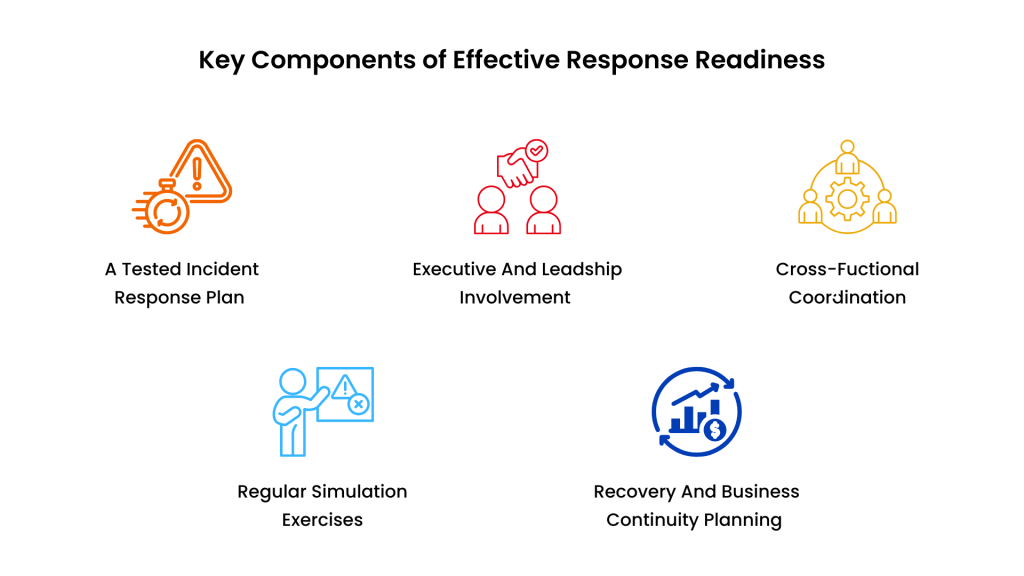
1. A Tested Incident Response Plan
An incident response plan should define:
- Roles and responsibilities
- Escalation procedures
- Communication workflows
- Technical containment processes
- Legal and compliance coordination
- Recovery priorities
Most importantly, the plan must be tested regularly through simulations and tabletop exercises.
A static document that has never been exercised will likely fail under real-world pressure.
2. Executive and Leadership Involvement
Cyber incidents are business crises, not purely technical events.
Leadership teams must understand:
- Their responsibilities during incidents
- Decision escalation paths
- Communication expectations
- Operational continuity priorities
Organizations that exclude executives from simulations often experience slower and less coordinated responses during actual incidents.
3. Cross-Functional Coordination
Effective response readiness requires collaboration between:
- Security teams
- IT operations
- Legal departments
- Communications teams
- HR
- Executive leadership
- Third-party vendors
Cyber incidents affect the entire organization. Preparedness efforts must therefore extend beyond technical departments.
4. Regular Simulation Exercises
Simulation exercises expose operational gaps before attackers do.
These exercises help organizations evaluate:
- Response speed
- Communication clarity
- Decision-making efficiency
- Escalation accuracy
- Recovery coordination
Tabletop exercises also improve leadership confidence during high-pressure situations.
5. Recovery and Business Continuity Planning
Incident response does not end with containment.
Organizations must also ensure:
- Reliable backup strategies
- Recovery prioritization
- Infrastructure resilience
- Vendor coordination
- Alternative operational workflows
Recovery planning determines how quickly organizations can restore normal business operations.
Cyber Readiness as a Competitive Advantage
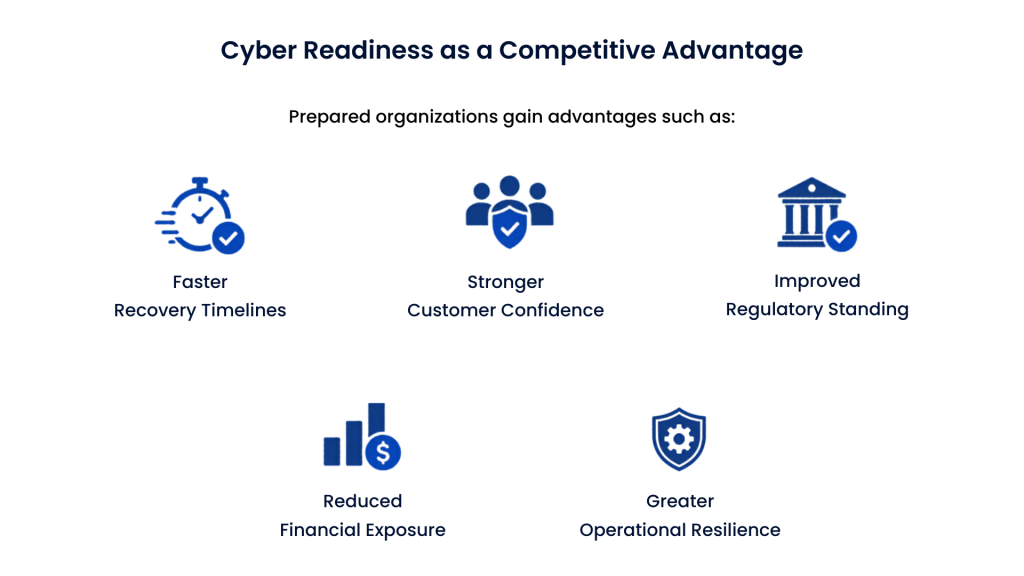
Organizations increasingly compete on resilience, reliability, and trust.
Customers, regulators, investors, and business partners now evaluate cybersecurity maturity as part of broader operational risk management.
Prepared organizations gain advantages such as:
- Faster recovery timelines
- Stronger customer confidence
- Improved regulatory standing
- Reduced financial exposure
- Greater operational resilience
Cyber readiness is no longer only a security initiative — it is a strategic business capability.
Final Thoughts
The cost of being unprepared for a cyber incident extends far beyond technical remediation. Downtime, financial losses, reputational damage, and delayed decision-making can disrupt an organization long after the original attack has been contained.
The organizations that recover strongest are not necessarily those with the largest security budgets. They are the ones that invest in preparation, response coordination, leadership alignment, and continuous testing.
Cyber incidents are inevitable.
Operational chaos does not have to be.Preparedness transforms cyber resilience from a reactive function into a business advantage.