
Human-centric attacks especially phishing, social engineering, and credential theft have quietly become the most expensive category of cyber risk. Unlike traditional exploits that target systems, these attacks target trust, behavior, and identity. The result is not just a security incident, but a multi-layered business disruption that impacts finances, operations, and long-term resilience.
1. Financial and Reputational Damage: Beyond the Breach Cost
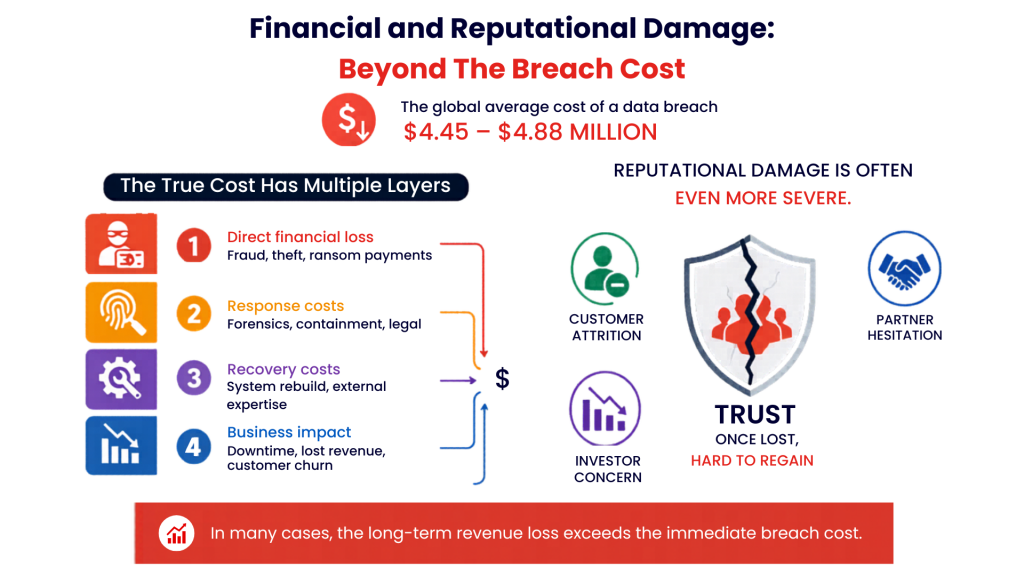
At a surface level, cyber incidents are already expensive. The global average cost of a data breach has reached $4.45–$4.88 million, factoring in response, recovery, legal, and lost business costs . But this number only captures part of the story.
A more realistic view separates costs into layers:
- Direct financial loss (fraud, theft, ransom payments)
- Breach response costs (forensics, containment, legal)
- Recovery costs (system rebuild, external expertise)
- Business impact (downtime, lost revenue, customer churn)
Human-centric attacks amplify each layer because they often:
- Go undetected longer
- Provide attackers legitimate access
- Enable deeper, multi-stage exploitation
Reputational damage is often even more severe. Trust—once lost—translates into:
- Customer attrition
- Partner hesitation
- Investor concern
In many cases, the long-term revenue loss exceeds the immediate breach cost .
2. The Hidden Multiplier: Credential Theft
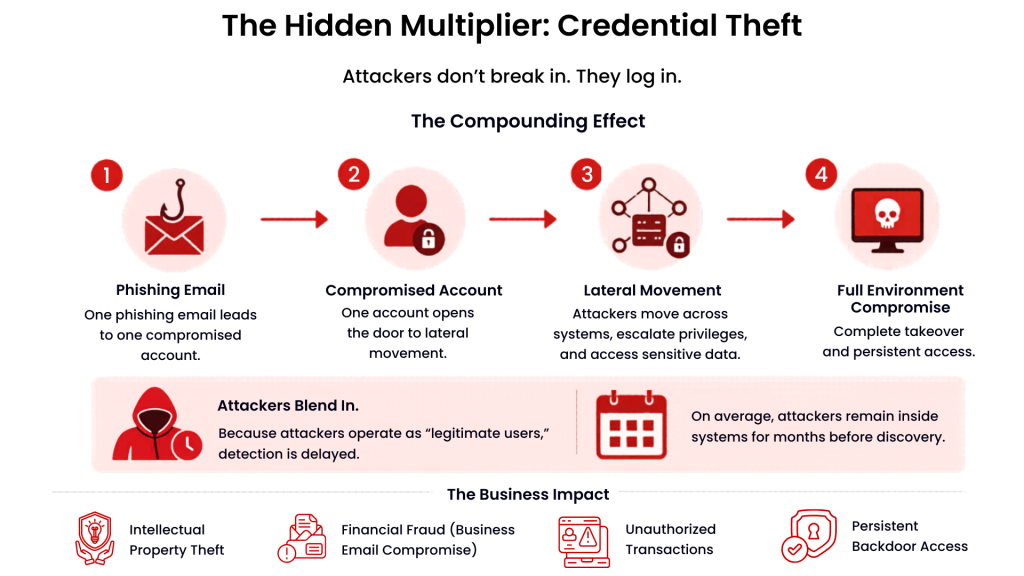
Credential theft is the backbone of human-centric attacks. Instead of breaking in, attackers log in.
Recent trends show:
- Credential theft has surged significantly, becoming a major share of breaches
- Compromised credentials enable stealth access, bypassing traditional defenses
- Many organizations take weeks or months to remediate exposed credentials
This creates a compounding effect:
- One phishing email → one compromised account
- One account → lateral movement
- Lateral movement → full environment compromise
Because attackers operate as “legitimate users,” detection is delayed. On average, attackers can remain inside systems for months before discovery .
The business impact:
- Intellectual property theft
- Financial fraud (e.g., business email compromise)
- Unauthorized transactions
- Persistent backdoor access
Credential theft turns a single human error into a systemic organizational risk.
3. Operational Disruption: When Business Stops
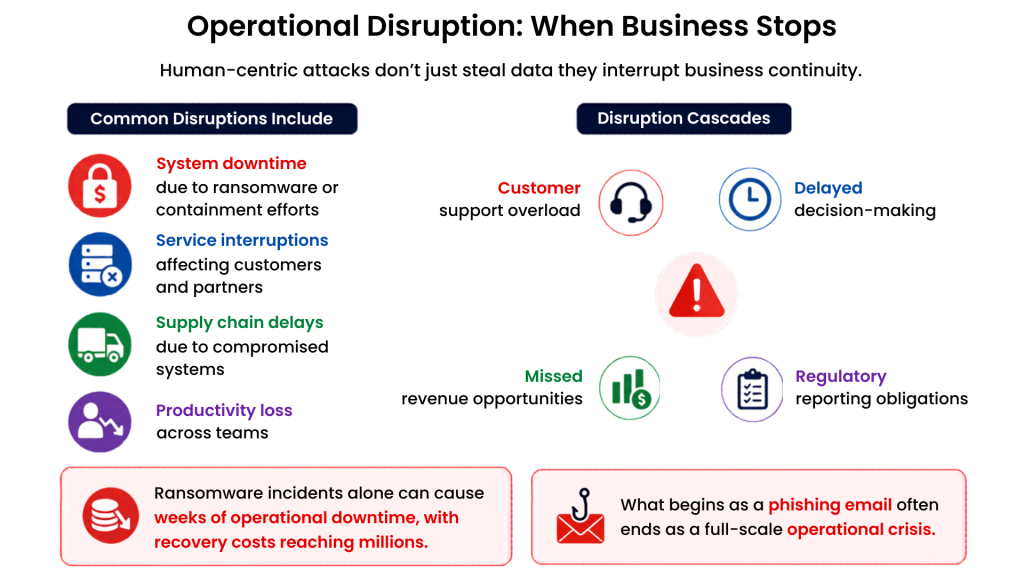
Human-centric attacks don’t just steal data they interrupt business continuity.
Common disruptions include:
- System downtime due to ransomware or containment efforts
- Service interruptions affecting customers and partners
- Supply chain delays due to compromised systems
- Productivity loss across teams
Ransomware incidents alone can cause weeks of operational downtime, with recovery costs reaching millions .
More critically, disruption cascades:
- Customer support overload
- Delayed decision-making
- Missed revenue opportunities
- Regulatory reporting obligations
What begins as a phishing email often ends as a full-scale operational crisis.
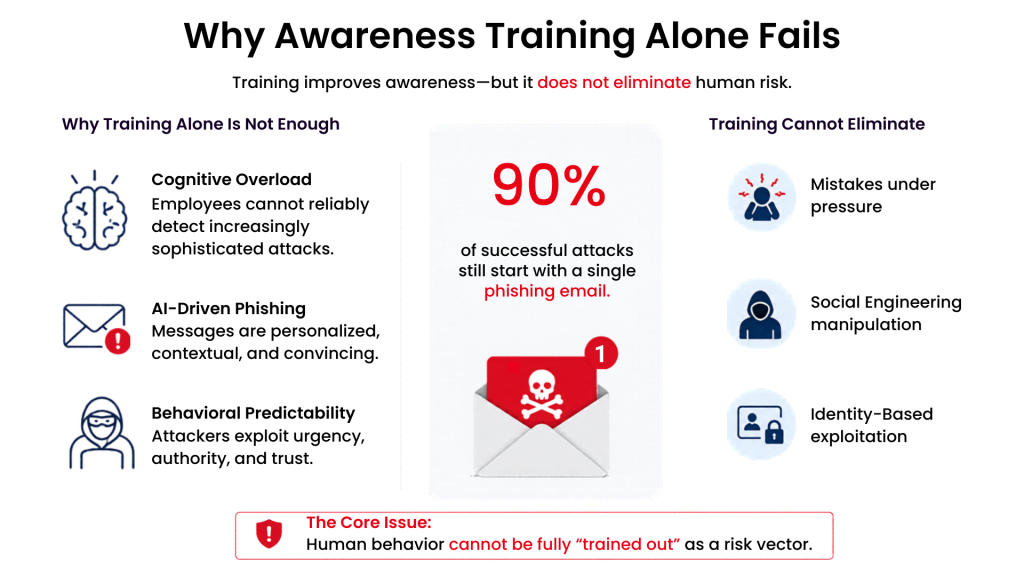
4. Why Awareness Training Alone Fails?
Most organizations respond to human-centric risk with awareness training. While necessary, it is insufficient.
Reasons include:
- Cognitive overload: Employees cannot reliably detect increasingly sophisticated attacks
- AI-driven phishing: Messages are personalized, contextual, and convincing
- Behavioral predictability: Attackers exploit urgency, authority, and trust
In fact, 90% of successful attacks still start with a single phishing email .
Training improves awareness—but it does not eliminate:
- Mistakes under pressure
- Social engineering manipulation
- Identity-based exploitation
The core issue:
Human behavior cannot be fully “trained out” as a risk vector.
5. Leadership Responsibility: Beyond Training
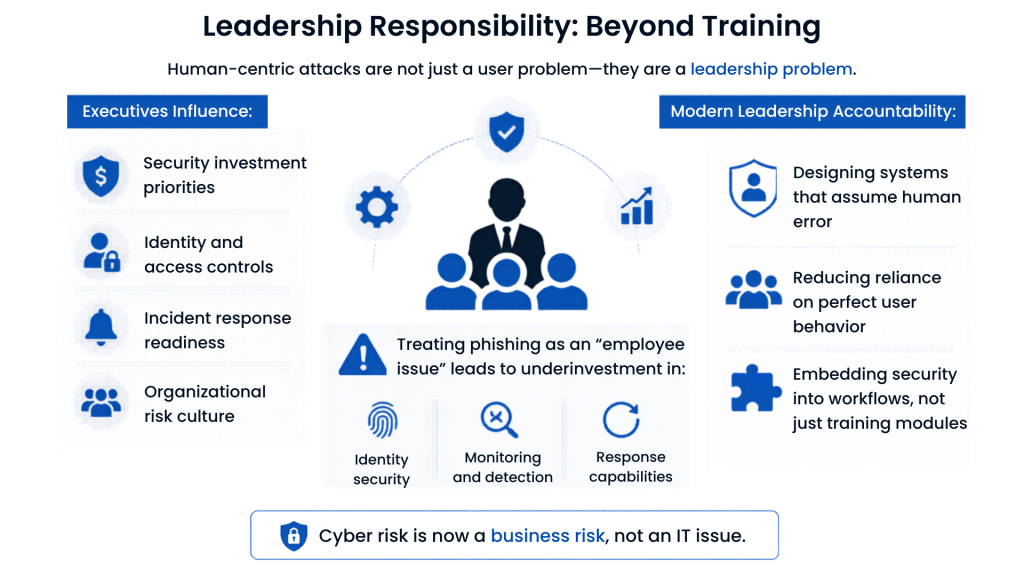
Human-centric attacks are not just a user problem they are a leadership problem.
Executives influence:
- Security investment priorities
- Identity and access controls
- Incident response readiness
- Organizational risk culture
Treating phishing as an “employee issue” leads to underinvestment in:
- Identity security
- Monitoring and detection
- Response capabilities
Modern leadership accountability includes:
- Designing systems that assume human error
- Reducing reliance on perfect user behavior
- Embedding security into workflows, not just training modules
Cyber risk is now a business risk, not an IT issue.
6. Building Resilience Beyond Awareness
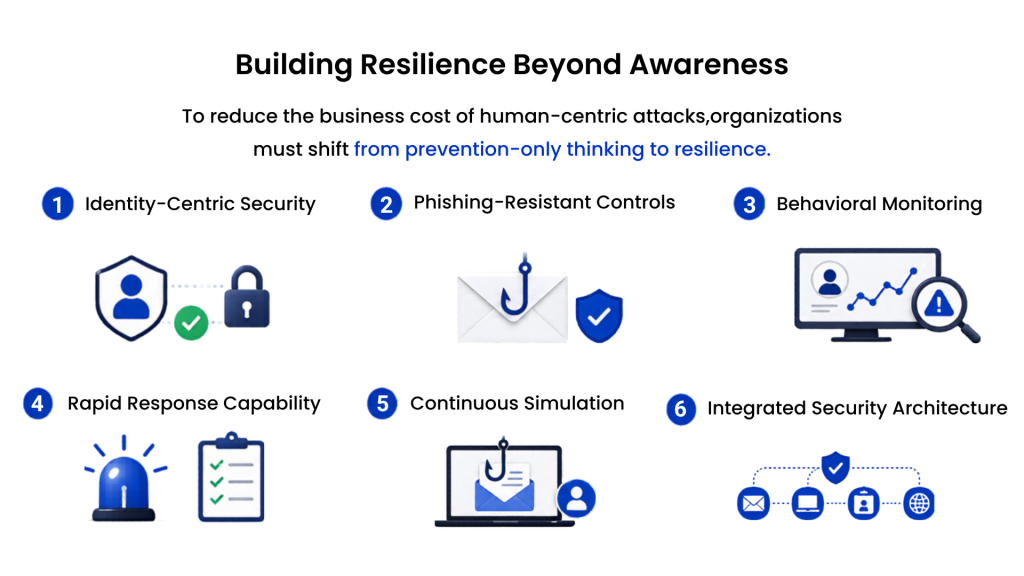
To reduce the business cost of human-centric attacks, organizations must shift from prevention-only thinking to resilience.
Key elements include:
1. Identity-Centric Security
- Zero Trust models
- Continuous authentication and validation
- Least privilege access
2. Phishing-Resistant Controls
- Strong multi-factor authentication (MFA)
- Hardware-based authentication where possible
3. Behavioral Monitoring
- Detect anomalies in user activity
- Identify compromised accounts early
4. Rapid Response Capability
- Predefined incident playbooks
- Automated containment actions
- Cross-functional coordination
5. Continuous Simulation
- Real-world phishing simulations
- Contextual, role-based training
6. Integrated Security Architecture
- Email, endpoint, identity, and network working together
- Not siloed defenses
7. The Strategic Reality
Human-centric attacks succeed not because technology is weak but because trust is exploitable.
The financial impact is measurable in millions.
The operational impact is measurable in downtime.
But the strategic impact is deeper:
- Erosion of trust
- Slower business velocity
- Increased regulatory scrutiny
- Long-term competitive disadvantage
Global cybercrime costs are projected to reach $10.5 trillion annually, underscoring the scale of the threat
Final Insight
The real business cost of human-centric attacks is not the breach itself.
It is the compounding effect across finance, operations, and trust.
Organizations that succeed will not be those that try to eliminate human error but those that design systems resilient to it.