
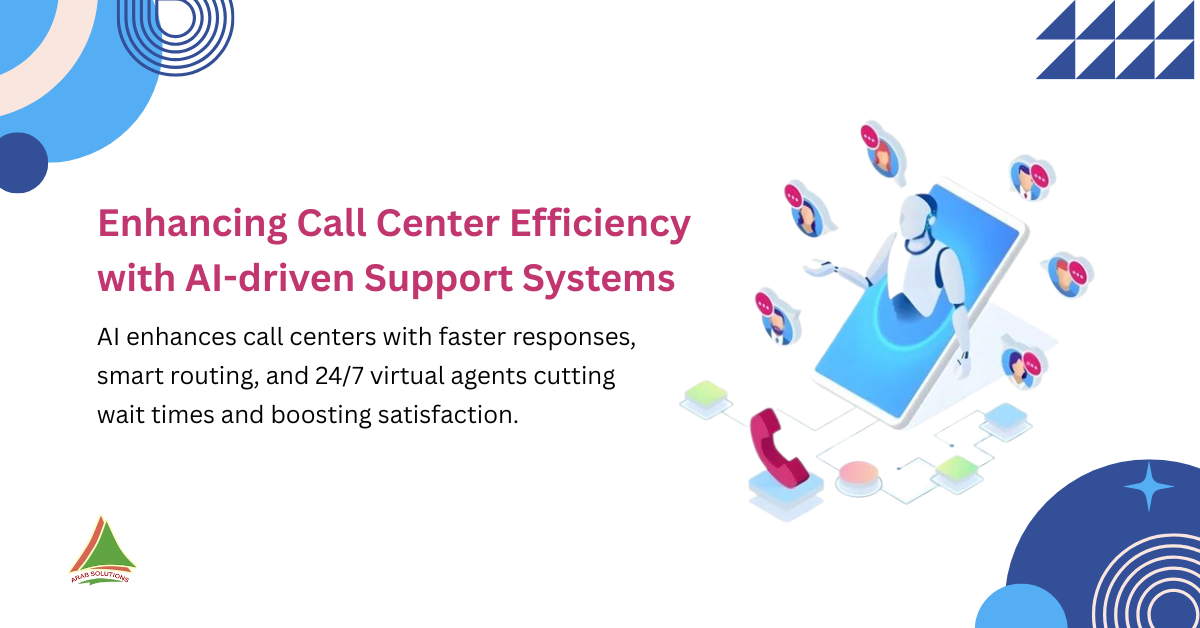
Introduction
Call centers are central to customer engagement across industries such as banking, healthcare, telecommunications, and retail. They shape customer perceptions, influence loyalty, and directly impact business performance.
However, many centers face persistent challenges: long wait times, high operating costs, and inconsistent service quality. These issues frustrate customers, create stress for agents, and limit the effectiveness of customer service operations.
AI-driven support systems address these challenges by embedding automation, data analysis, and advanced interaction tools into daily workflows. Instead of replacing human agents, they help streamline operations, reduce inefficiencies, and improve the overall customer experience.
Why Traditional Models Struggle?
Conventional call centers often rely on manual processes and static rule-based systems. These methods fall short in:
- Managing spikes in call volume.
- Handling repetitive, routine inquiries.
- Resolving complex issues that need cross-team coordination.
- Monitoring quality at scale.
- Retaining employees in high-pressure environments.
The outcome is higher costs, lower productivity, and growing customer dissatisfaction.
AI-Driven Solutions for Call Centers
1. Virtual Assistants
AI-powered virtual assistants handle high-frequency, low-complexity interactions such as billing inquiries, appointment scheduling, or password resets. They:
- Reduce workload for agents.
- Provide 24/7 availability.
- Deliver consistent responses across channels.
2. Real-Time Support for Agents
AI tools can analyze live conversations and provide:
- Prompts and suggestions to resolve issues quickly.
- Compliance alerts during sensitive interactions.
- Recommendations from knowledge bases without manual searching.
This helps agents work more efficiently while improving the quality of conversations.
3. Smarter Call Routing
Instead of assigning calls to the next available agent, AI systems evaluate customer history, issue type, and agent skills to route calls more effectively.
- Improves first-call resolution.
- Reduces call transfers and escalations.
- Enhances customer satisfaction through personalized service.
4. Automated Quality Monitoring
Traditional monitoring checks only a small sample of calls. AI systems can analyze every interaction, identifying:
- Common customer complaints.
- Agent training needs.
- Compliance risks in regulated sectors.
This ensures continuous quality improvement across the entire call center.
5. Workforce Optimization
AI-based forecasting tools predict call volumes using historical and real-time data. This helps:
- Schedule the right number of agents.
- Reduce idle time and unnecessary overtime.
- Balance workloads across shifts and channels.
Benefits of AI-Driven Support Systems
- Productivity Gains: Agents focus on complex tasks instead of repetitive queries.
- Lower Costs: Optimized staffing and shorter call handling reduce expenses.
- Better Customer Experience: Faster, more accurate responses build trust.
- Scalability: Systems can handle large call volumes without extra headcount.
- Data Insights: Analysis of conversations reveals service gaps and customer needs.
Challenges to Address
Adopting AI in call centers requires careful planning:
- Integration Issues: Many organizations still rely on legacy systems.
- Data Privacy: Sensitive customer data must be managed securely.
- Employee Training: Agents need to learn how to work effectively with new tools.
- Over-Automation Risks: Human interaction remains critical for sensitive or complex issues.
The Road Ahead
AI support systems are moving toward anticipatory service models, where customer needs are predicted before they reach out. This includes:
- Proactive outreach based on past behavior.
- Early detection of service issues.
- Integration with enterprise platforms for end-to-end resolution.
Call centers will increasingly serve as hubs of customer intelligence, providing insights that guide not only service but also product development, marketing, and business strategy.
Conclusion
AI-driven support systems improve call center efficiency by automating repetitive tasks, enhancing agent performance, and enabling better resource planning. When implemented thoughtfully, they deliver measurable improvements in productivity, cost control, and customer satisfaction.
For organizations that view customer service as a differentiator, these systems provide a practical path toward stronger operations and more consistent customer outcomes.