

Introduction
Every second, industrial systems across the globe are performing billions of operations powering cities, manufacturing goods, managing water supplies, and transporting people and resources. These systems, collectively known as Operational Technology (OT), form the backbone of the modern world. They ensure that energy flows, production continues, and essential services remain uninterrupted.
But as these once-isolated systems become increasingly connected to digital networks, a new and dangerous frontier has emerged: cyber threats targeting OT environments.
From ransomware attacks that shut down fuel pipelines to malware that manipulates safety controls in nuclear facilities, the risks are no longer theoretical. They are real, escalating, and capable of causing both economic and physical harm.
In this interconnected age, protecting OT systems is not just about data security it’s about safeguarding human lives, national infrastructure, and economic stability.
What Exactly Is OT Cybersecurity?
Operational Technology refers to the hardware and software systems that monitor and control physical devices, processes, and events in industries such as manufacturing, energy, transportation, and utilities. Examples include Programmable Logic Controllers (PLCs), Distributed Control Systems (DCS), and Supervisory Control and Data Acquisition (SCADA) systems.
These systems are the nerve centers of industrial operations they control temperature in power plants, pressure in pipelines, robotic movements on factory floors, and signaling systems in rail networks.
OT Cybersecurity, therefore, encompasses the practices, technologies, and policies that protect these control systems from unauthorized access, malicious manipulation, and accidental disruption.
While IT cybersecurity focuses on protecting data, OT cybersecurity focuses on protecting processes and physical assets. In IT, a system outage might cause data loss or productivity disruption. In OT, it could lead to physical damage, safety incidents, or large-scale operational shutdowns.
Why OT Cybersecurity Matters More Than Ever?
Traditionally, OT networks were “air-gapped,” meaning they were isolated from external systems and the internet. This physical separation once served as a strong line of defense. However, with the rise of the Industrial Internet of Things (IIoT), cloud computing, and remote monitoring, air gaps have virtually disappeared.
Organizations now connect their OT systems to IT networks to enable predictive maintenance, real-time analytics, and centralized control. While this integration enhances efficiency and insight, it also dramatically increases the attack surface.
A breach in an IT system can now serve as a gateway to OT networks allowing attackers to manipulate industrial processes, disable safety mechanisms, or cause widespread disruption.
The potential consequences are severe:
- Downtime and revenue loss: A single ransomware incident can halt production for weeks.
- Safety risks: Tampering with control systems can lead to equipment explosions, chemical leaks, or worker injuries.
- Environmental damage: Compromised systems in power or water plants can cause large-scale contamination or pollution.
- National security threats: Critical infrastructure such as power grids or oil pipelines can be targeted by state-sponsored cyberattacks.
The stakes of OT cybersecurity extend beyond business they affect society at large.
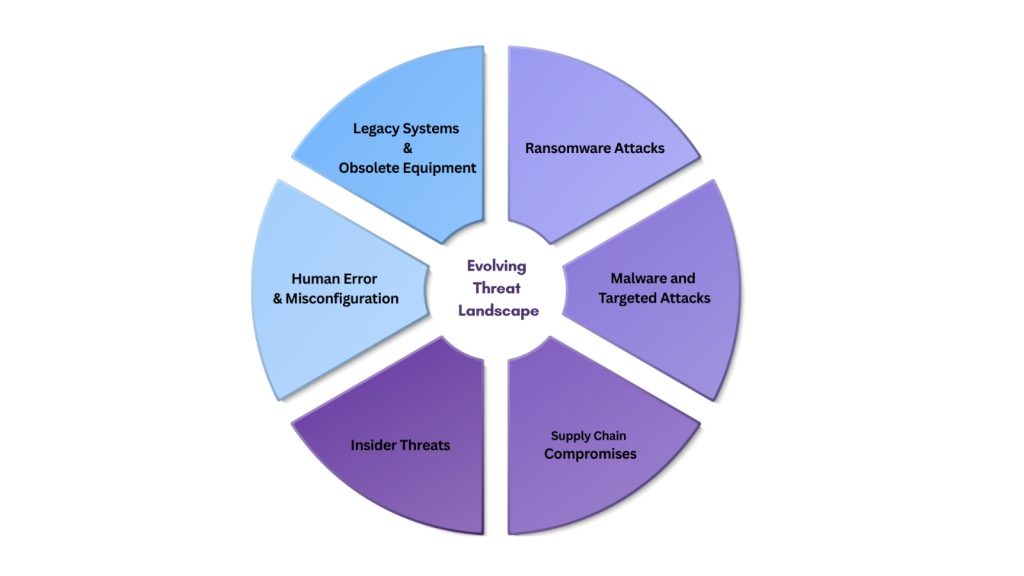
Evolving Threat Landscape
The cybersecurity threats facing OT systems are evolving rapidly. Attackers are becoming more sophisticated, often leveraging advanced persistent threats (APTs) to remain undetected while gathering intelligence or preparing for large-scale disruption.
Some of the major OT cyber threats today include:
1. Ransomware Attacks
Attackers infiltrate networks, encrypt operational data or control files, and demand payment to restore functionality. The Colonial Pipeline attack in 2021 is a prime example it forced a major U.S. fuel pipeline to shut down operations for days, disrupting national fuel distribution.
2. Malware and Targeted Attacks
Malware such as Stuxnet, Triton (Trisis), and Industroyer have demonstrated the potential of cyberweapons to physically damage equipment or disable safety systems.
3. Supply Chain Compromises
Hackers infiltrate trusted third-party vendors, embedding malicious code into legitimate software updates. Once deployed, these updates compromise multiple industrial systems simultaneously.
4. Insider Threats
Employees, contractors, or maintenance personnel whether intentional or negligent can introduce vulnerabilities by bypassing procedures, connecting unauthorized devices, or sharing credentials.
5. Human Error and Misconfiguration
Simple mistakes such as weak passwords, unpatched systems, or improper firewall settings can open doors to major breaches.
6. Legacy Systems and Obsolete Equipment
Many OT environments rely on outdated systems that cannot be updated or replaced easily. These legacy assets often lack encryption, authentication, and modern security mechanisms making them ideal targets for attackers.
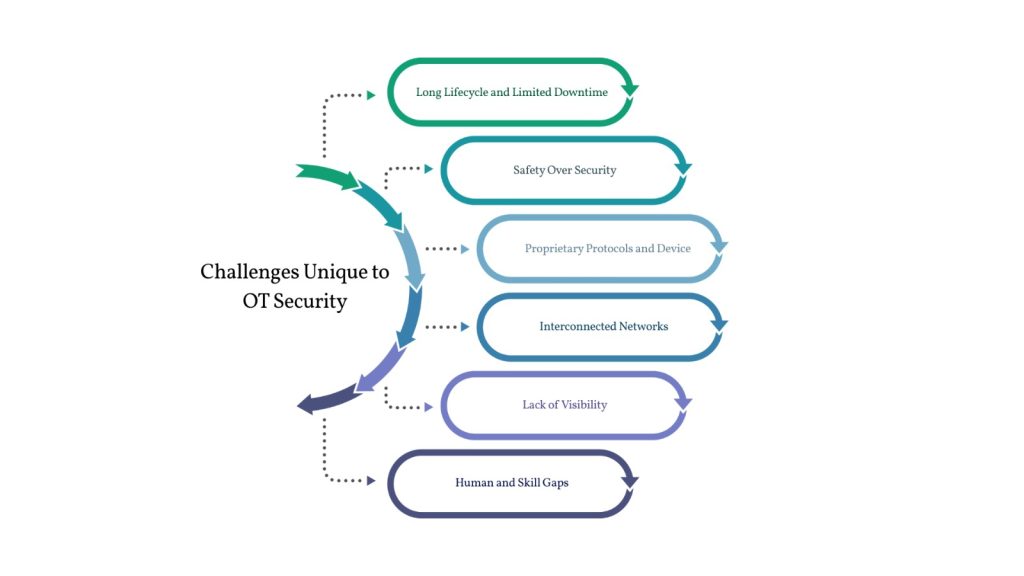
Challenges Unique to OT Security
Securing OT systems presents unique complexities that differ fundamentally from IT security:
- Long Lifecycle and Limited Downtime:
Industrial equipment often operates continuously for decades. Shutting down systems for updates or patches can halt production, leading to enormous financial losses. - Safety Over Security:
OT systems are designed to prioritize operational safety and reliability over cybersecurity. Many were built before cyber risks existed, leaving inherent vulnerabilities. - Proprietary Protocols and Devices:
OT environments use specialized, vendor-specific communication protocols that standard IT tools cannot interpret or secure. - Interconnected Networks:
The growing integration of IT and OT systems means a compromise in one environment can easily spread to the other. - Lack of Visibility:
Many organizations lack a complete inventory of all connected OT assets, creating blind spots for attackers to exploit. - Human and Skill Gaps:
OT cybersecurity requires a blend of engineering, IT, and security expertise skills that remain in short supply across industries.
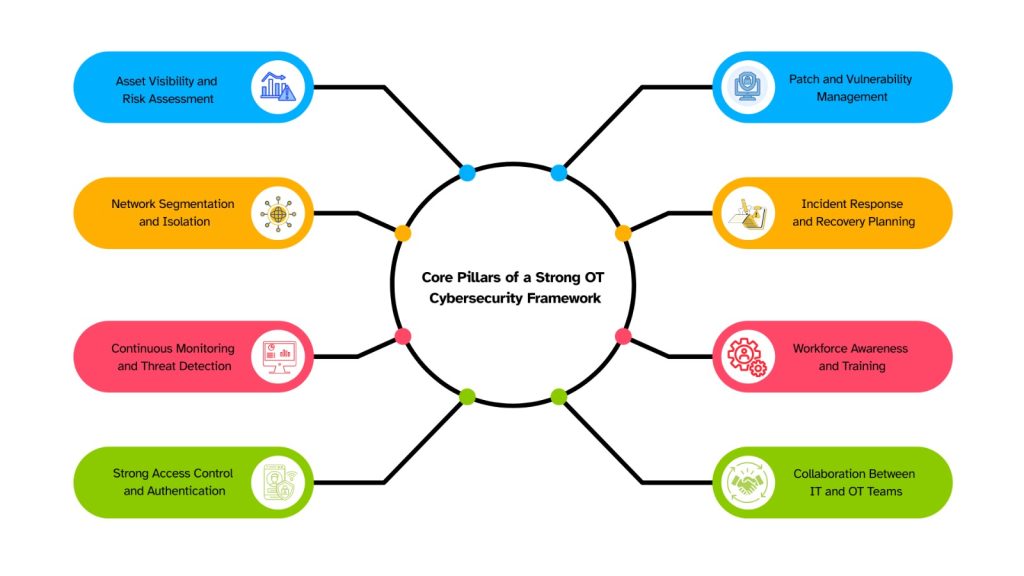
Core Pillars of a Strong OT Cybersecurity Framework
To build resilience, organizations must adopt a comprehensive, layered defense strategy that addresses both technology and human factors. Key components include:
1. Asset Visibility and Risk Assessment
Begin by identifying every device, system, and software application connected to the OT network. Conduct detailed risk assessments to determine which systems are most critical and vulnerable. Complete visibility enables effective prioritization of defenses.
2. Network Segmentation and Isolation
Segregate OT networks from corporate IT and external systems using firewalls, demilitarized zones (DMZs), and one-way communication gateways. This limits the spread of potential attacks and reduces exposure.
3. Continuous Monitoring and Threat Detection
Deploy intrusion detection systems (IDS) and security monitoring tools specifically designed for OT environments. These tools analyze industrial communication protocols, detect anomalies, and trigger alerts before damage occurs.
4. Strong Access Control and Authentication
Implement multi-factor authentication, role-based access, and least-privilege principles. Limit user permissions strictly to operational requirements. Regularly review and revoke unnecessary credentials.
5. Patch and Vulnerability Management
Many OT systems cannot be updated frequently. In such cases, use virtual patching, network isolation, and application whitelisting to mitigate risk. Schedule maintenance windows strategically for updates when possible.
6. Incident Response and Recovery Planning
Prepare for the inevitable. Develop an OT-specific incident response plan that includes containment, recovery, forensic analysis, and communication strategies. Conduct simulations and regular drills to ensure operational readiness.
7. Workforce Awareness and Training
Educate operators, engineers, and technicians about cybersecurity best practices. Regular awareness programs help employees recognize phishing attempts, suspicious activity, and unsafe behaviors.
8. Collaboration Between IT and OT Teams
Encourage alignment between IT security professionals and OT engineers. Shared governance models, unified risk frameworks, and coordinated incident response teams strengthen overall resilience.
The Power of IT-OT Convergence
The convergence of IT and OT offers immense benefits real-time analytics, predictive maintenance, and operational efficiency. But it also demands a unified security posture.
A successful strategy bridges the gap between both domains by ensuring:
- Consistent security policies across IT and OT systems.
- Shared threat intelligence and coordinated response actions.
- Common governance frameworks like NIST Cybersecurity Framework (CSF) and IEC 62443.
- Centralized monitoring via Security Operations Centers (SOCs) capable of analyzing both IT and OT events.
When IT and OT teams operate as one, organizations achieve not only stronger cybersecurity but also better operational visibility and control.
Emerging Technologies Enhancing OT Cybersecurity
The next generation of OT defense leverages advanced technologies that enhance detection, prevention, and resilience:
- Artificial Intelligence (AI) and Machine Learning (ML): Enable predictive threat detection, identifying unusual patterns before they escalate into incidents.
- Zero Trust Architecture (ZTA): Eliminates implicit trust within networks—every user, device, and connection must be continuously verified.
- Blockchain: Ensures data integrity and transparency in supply chains, preventing unauthorized code modifications.
- Digital Twins: Virtual replicas of OT systems allow organizations to simulate cyberattacks, test security responses, and strengthen resilience without risking live operations.
- Secure Remote Access Platforms: Provide controlled, encrypted connections for vendors and field technicians, reducing exposure during maintenance activities.
Compliance and Global Regulations
As cyber threats to critical infrastructure increase, regulatory bodies worldwide have introduced stringent compliance requirements for OT environments.
Some of the leading frameworks include:
- NIST SP 800-82 – Guide to Industrial Control System Security
- IEC 62443 – International standard for industrial automation and control systems
- ISO/IEC 27019 – Security management for energy utility systems
- NERC CIP – North American standards for power grid protection
- EU NIS2 Directive – Strengthening security for essential and digital service providers
Compliance ensures organizations meet baseline security expectations, demonstrate due diligence, and maintain customer and stakeholder trust.