Moving Beyond Tools to Enterprise Resilience
For years, security architecture has been treated as a technical function — a collection of controls, tools, and frameworks designed to reduce cyber risk.
But in modern enterprises, security architecture is not an IT decision. It is a strategic business decision.
Organizations that understand this build resilience.
Those that don’t accumulate complexity, cost, and hidden risk.
Cyber Risk Is Operational Risk
Cyber risk is no longer just a “security issue.” It is:
- Revenue risk
- Supply chain risk
- Regulatory risk
- Brand and reputation risk
- Board-level governance risk
A ransomware attack doesn’t just encrypt data — it halts production.
A cloud misconfiguration doesn’t just expose systems — it disrupts customer trust.
In digital-first enterprises, technology is the business. Therefore:
A failure in cyber architecture is a failure in operational continuity.
Treating cyber risk as separate from operational risk leads to underinvestment, fragmented controls, and reactive spending after incidents occur.
Strategic organizations embed security architecture into:
- Enterprise risk management
- Business continuity planning
- Digital transformation programs
- M&A integration strategy
- Cloud modernization roadmaps
When security architecture is aligned with business operations, it becomes a resilience engine — not a cost center.
Why CISOs Struggle with Fragmented Tools?
Most CISOs inherit environments shaped by years of:
- Vendor-driven procurement
- Compliance-based buying
- Incident-response purchases
- Department-level tool selection
- Budget silos
The result?
Tool sprawl.
It’s common to see enterprises running:
- 40–80+ security products
- Overlapping capabilities
- Redundant telemetry
- Multiple identity stores
- Disconnected policy engines
This fragmentation creates four major problems:
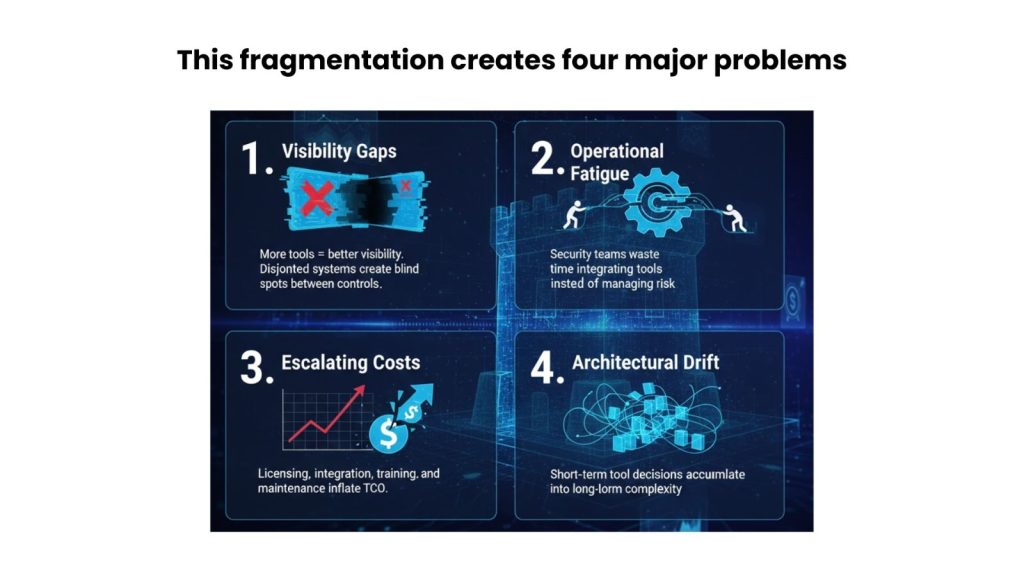
1. Visibility Gaps
More tools ≠ better visibility.
Disjointed systems create blind spots between controls.
2. Operational Fatigue
Security teams waste time integrating tools instead of managing risk.
3. Escalating Costs
Licensing, integration, training, and maintenance inflate TCO.
4. Architectural Drift
Short-term tool decisions accumulate into long-term complexity.
CISOs struggle not because they lack tools —
they struggle because tools were acquired without architectural int
Security architecture should define:
- Control domains
- Trust boundaries
- Identity flows
- Data protection models
- Logging and telemetry strategy
Tools should follow architecture — not the other way around.
Governance-Driven Security Design
Strategic security architecture begins with governance.
Not vendor demos.
Not compliance checklists.
Not trend-driven adoption.
Governance-driven design answers:
- What business processes are mission-critical?
- What data must never be exposed?
- What regulatory obligations shape control design?
- Who owns risk decisions?
- What are the acceptable recovery timelines?
When governance leads, architecture becomes intentional.
Key Governance Principles
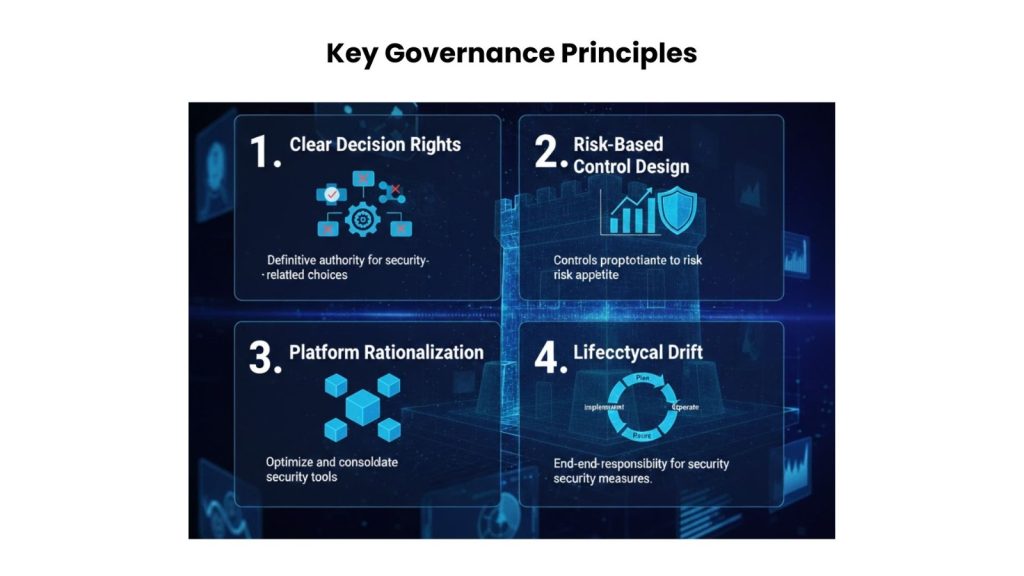
1. Clear Decision Rights
Who approves architectural standards?
Who approves deviations?
Who owns cost vs risk trade-offs?
2. Risk-Based Control Design
Controls mapped to quantified business impact — not generic frameworks.
3. Platform Rationalization
Consolidate capabilities under coherent domains:
- Identity
- Endpoint
- Network
- Cloud
- Data
- Observability
4. Lifecycle Accountability
Security architecture should evolve with:
- Cloud adoption
- DevOps maturity
- AI integration
- Business expansion
Governance-driven architecture reduces chaos.
It transforms security from reactive spending to structured investment.
Long-Term Resilience vs Short-Term Procurement Decisions
One of the biggest threats to enterprise security maturity is short-termism.
Short-term procurement decisions are driven by:
- Budget cycles
- Audit findings
- Breach headlines
- Vendor discounts
- Executive pressure
These decisions optimize for immediate closure — not systemic resilience.
The Long-Term Resilience Approach
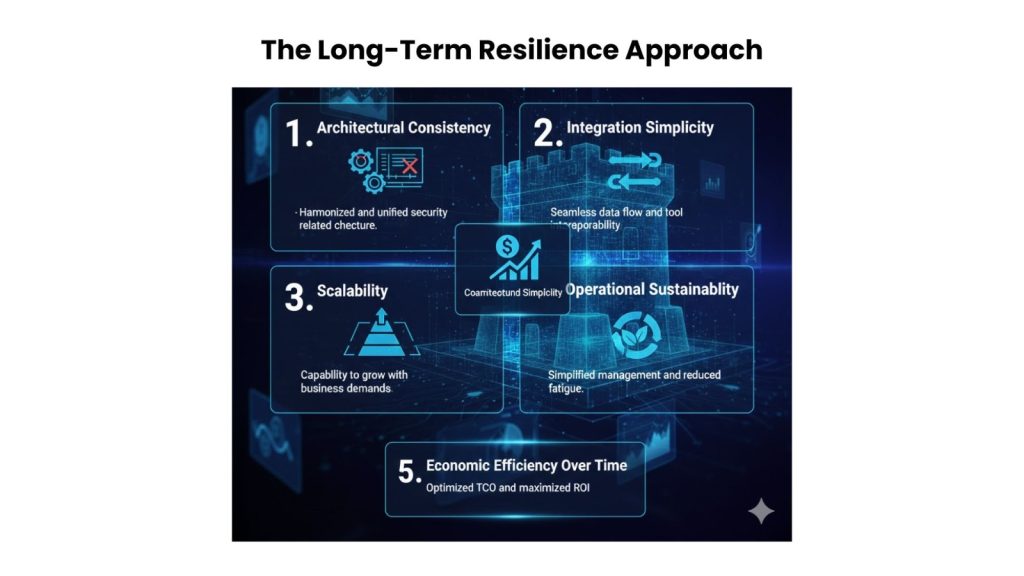
Resilient organizations prioritize:
1. Architectural Consistency
Every tool must fit a defined security model.
2. Integration Simplicity
Fewer platforms, stronger interoperability.
3. Scalability
Controls that grow with cloud, remote workforce, and digital expansion.
4. Operational Sustainability
Security programs that teams can realistically manage.
5. Economic Efficiency Over Time
Lower complexity = lower hidden cost.
Short-term savings often create long-term technical debt.
And in security, technical debt becomes vulnerability debt.
Security Architecture as Competitive Advantage
Forward-looking boards are beginning to ask different questions:
- Is our security architecture scalable?
- Can we absorb a major incident without operational collapse?
- Are we overpaying for fragmented controls?
- Is security enabling or slowing digital transformation?
When security architecture is strategic:
- Cloud adoption accelerates.
- M&A integrations become smoother.
- Regulatory compliance becomes predictable.
- Incident recovery becomes structured.
- Investor confidence improves.
Security stops being friction — and starts becoming leverage.
The Shift That Must Happen
Organizations must move from:
Tool-centric security
to
Architecture-centric security
From reactive procurement
to
governance-led design
From compliance-driven spending
to
resilience-driven investment
From “How many tools do we have?”
to
“How coherently are we protected?”
Final Thought
Security architecture is not about buying better tools.
It is about designing a defensible, scalable, economically sustainable operating model for digital business.
The enterprises that understand this will not just survive the next wave of cyber disruption —
They will absorb it, adapt, and continue operating with confidence.
Because resilience is not accidental.
It is architected.