

In 2026, digital transformation is no longer a strategic initiative — it is the operational backbone of modern enterprises. Industrial control systems connect to cloud analytics platforms. AI engines influence production scheduling. Remote vendors access plant environments. Smart devices continuously stream operational telemetry.
This is the converged enterprise — where Operational Technology (OT), Information Technology (IT), cloud platforms, and AI systems operate as one integrated ecosystem.
Convergence creates efficiency, automation, and predictive intelligence. It also introduces systemic risk.
Security in 2026 must protect:
- Physical operations
- Digital infrastructure
- Autonomous AI decisions
- Regulatory compliance posture
- Organizational resilience
The challenge is no longer preventing isolated cyberattacks — it is managing interconnected risk across technical, operational, and governance layers.
Understanding OT/IT Convergence Risk
Traditionally:
- OT systems prioritized availability, safety, and deterministic performance.
- IT systems prioritized connectivity, scalability, and data exchange.
Convergence introduces:
• Expanded attack surfaces
• Shared identity and access layers
• Cloud-connected industrial assets
• Increased supply chain exposure
• AI-driven operational dependency
A compromise in IT can now cascade into OT environments — disrupting production lines, utilities, transportation systems, or healthcare services.
Security must therefore shift from perimeter-based defense to integrated risk governance.
OT Visibility Strategies: Moving Beyond Asset Lists
Visibility is not a dashboard. It is continuous situational awareness across cyber-physical systems.
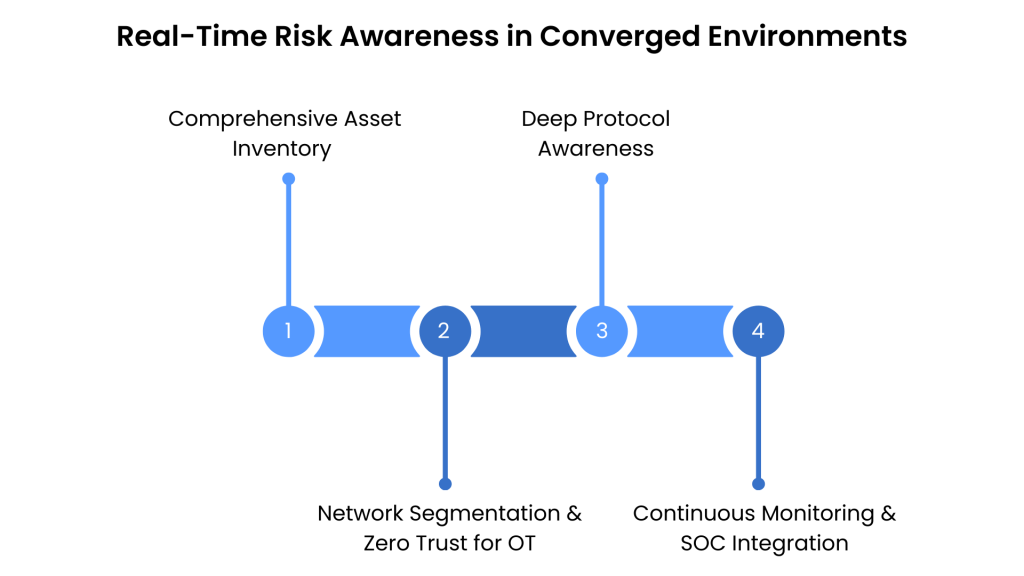
1. Comprehensive Asset Inventory
Organizations must maintain dynamic inventories that include:
- PLCs, RTUs, HMIs
- SCADA servers
- Edge gateways
- Industrial IoT sensors
- Remote maintenance endpoints
- Third-party vendor connections
- AI-enabled control modules
Unlike IT assets, many OT systems run legacy firmware and cannot tolerate active scanning. Passive monitoring and protocol-aware discovery tools are essential.
2. Deep Protocol Awareness
Industrial environments rely on protocols such as Modbus, DNP3, OPC-UA, and Profinet. Traditional IT security tools lack deep inspection capabilities for these protocols.
Security architecture must:
- Identify abnormal command sequences
- Detect unauthorized configuration changes
- Flag unusual control instructions
- Monitor lateral movement between segments
3. Network Segmentation & Zero Trust for OT
Flat networks allow attackers to move from user laptops to critical controllers.
Modern OT segmentation includes:
- Strict separation between IT and OT
- Micro-segmentation of production cells
- Identity-based access control
- Just-in-time privileged access
- Encrypted remote maintenance tunnels
Zero Trust in OT does not mean constant disruption — it means contextual validation without compromising uptime.
4. Continuous Monitoring & SOC Integration
Security Operations Centers must integrate OT telemetry into centralized monitoring platforms.
This requires:
- Unified logging pipelines
- Correlated threat intelligence
- AI-assisted anomaly detection
- Cross-domain incident response playbooks
Platform-Based Security Architecture: Reducing Fragmentation
Tool sprawl weakens control. Enterprises often deploy dozens of disconnected tools across IT, cloud, and OT — creating visibility gaps.
A platform-based architecture consolidates:
- Identity and access management
- Endpoint detection & response
- Network security
- Cloud security posture management
- OT monitoring
- AI governance dashboards
- Compliance automation
The objective is policy consistency.
Architectural Pillars
1. Identity as the Control Plane
Every user, device, workload, and AI system must have a verifiable identity.
Role-based and attribute-based access control enforce least privilege across environments.
2. Data-Centric Security
Data classification and encryption must extend across:
- On-prem systems
- Edge environments
- Multi-cloud deployments
3. Unified Risk Scoring
Risk should not be measured separately for IT, OT, and AI.
A centralized risk model enables leadership visibility and board-level reporting.
4. Secure-by-Design Engineering
Security must be embedded into system design — not retrofitted post-deployment.
AI Risk Governance in the Operational Enterprise
AI is no longer experimental. It now drives:
- Predictive maintenance
- Automated quality inspection
- Demand forecasting
- Cyber threat detection
- Autonomous process control
When AI systems influence operational decisions, governance must match their impact.
Key AI Risk Domains
• Data poisoning and adversarial manipulation
• Model drift affecting operational accuracy
• Bias impacting automated decisions
• Lack of explainability in high-impact environments
• Regulatory non-compliance
Building an AI Governance Framework
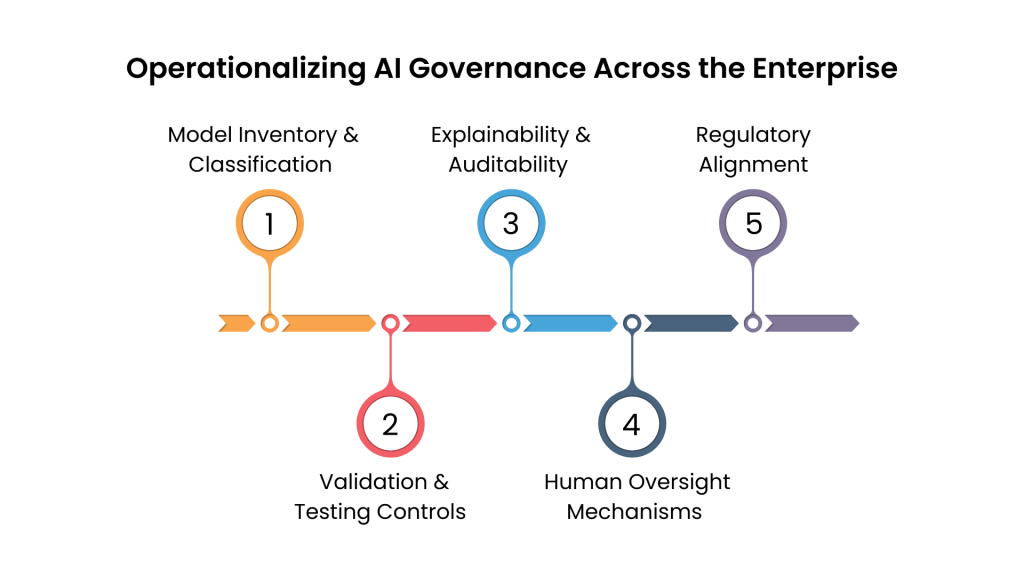
1. Model Inventory & Classification
Enterprises must maintain a catalog of deployed AI models, categorized by criticality and impact.
2. Validation & Testing Controls
Models require:
- Pre-deployment validation
- Stress testing under edge conditions
- Bias evaluation
- Ongoing performance monitoring
3. Explainability & Auditability
Decisions that impact safety, production, or customers must be traceable and explainable.
4. Human Oversight Mechanisms
Critical AI-driven actions should include override capabilities and review workflows.
5. Regulatory Alignment
Organizations operating in global markets must align with emerging AI governance frameworks such as:
- EU AI Act
- NIST AI Risk Management Framework
AI governance is not about restricting innovation — it ensures sustainable deployment.
Compliance & Resilience Alignment
Security and compliance must converge into operational resilience.
Modern regulations demand demonstrable governance across OT, IT, and AI ecosystems. Key frameworks influencing 2026 strategies include:
- NIS2 Directive
- IEC 62443
- ISO/IEC 27001
- DORA
Compliance alignment requires:
• Integrated risk registers
• Cross-functional governance committees
• Regular resilience testing
• Third-party risk assessments
• Executive reporting transparency
Resilience is measured by recovery speed — not by the absence of incidents.
Executive-Level Governance in 2026
Boards and executive leadership must shift from reactive cybersecurity oversight to proactive risk orchestration.
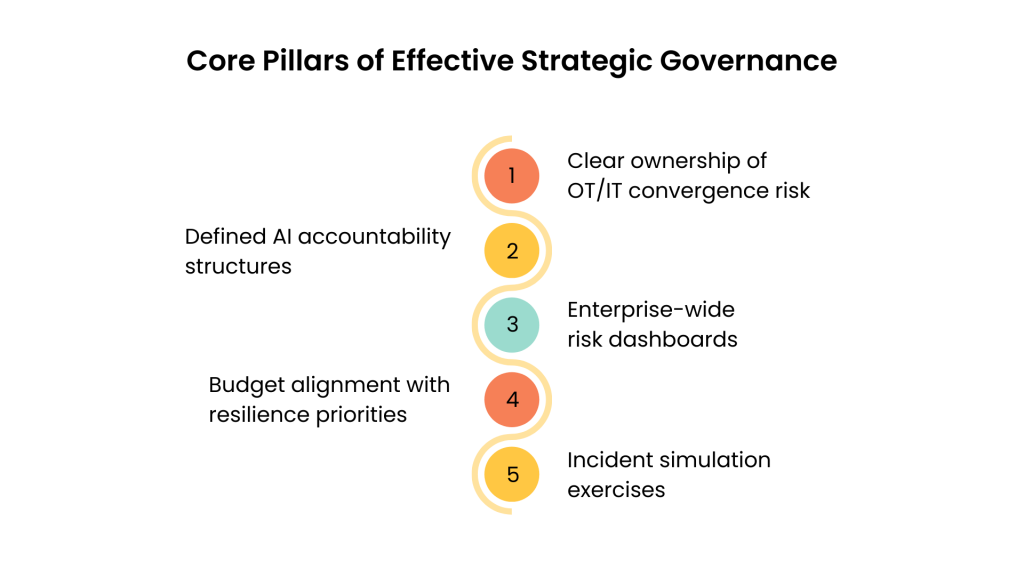
Strategic governance should include:
- Clear ownership of OT/IT convergence risk
- Defined AI accountability structures
- Enterprise-wide risk dashboards
- Budget alignment with resilience priorities
- Incident simulation exercises
Security maturity is a governance discipline — not a technology checklist.
The Road Ahead
In 2026, enterprises face a defining choice:
Integrate securely — or integrate vulnerably.
The organizations that succeed will:
- Build unified visibility
- Consolidate architecture
- Govern AI responsibly
- Align compliance with resilience
- Treat security as a strategic enabler
OT/IT convergence and AI adoption are accelerators of growth.
Governance determines whether they accelerate opportunity — or accelerate risk.