
Modern enterprises are facing a cybersecurity paradox. While organizations continue investing heavily in security technologies, many are becoming less efficient, more fragmented, and increasingly difficult to manage. Over the past few years, businesses have accumulated dozens of disconnected security tools across cloud, endpoint, identity, network, compliance, and threat intelligence environments. Instead of improving protection, this “tool sprawl” often creates operational confusion, alert fatigue, visibility gaps, and rising costs.
As cyber threats become more sophisticated — especially with the rise of AI-driven attacks, automated threat actors, deepfakes, and multi-vector ransomware campaigns — organizations are shifting toward security consolidation frameworks designed to simplify operations while strengthening security posture. Industry research and enterprise trends in 2026 show that platformization, AI-powered SOC integration, and unified security architectures are becoming strategic priorities for CISOs globally.
The Growing Problem of Security Tool Sprawl
Most enterprises today operate with multiple overlapping security solutions acquired over several years. Different teams often deploy independent tools for endpoint protection, SIEM, identity management, cloud security, vulnerability scanning, and incident response.
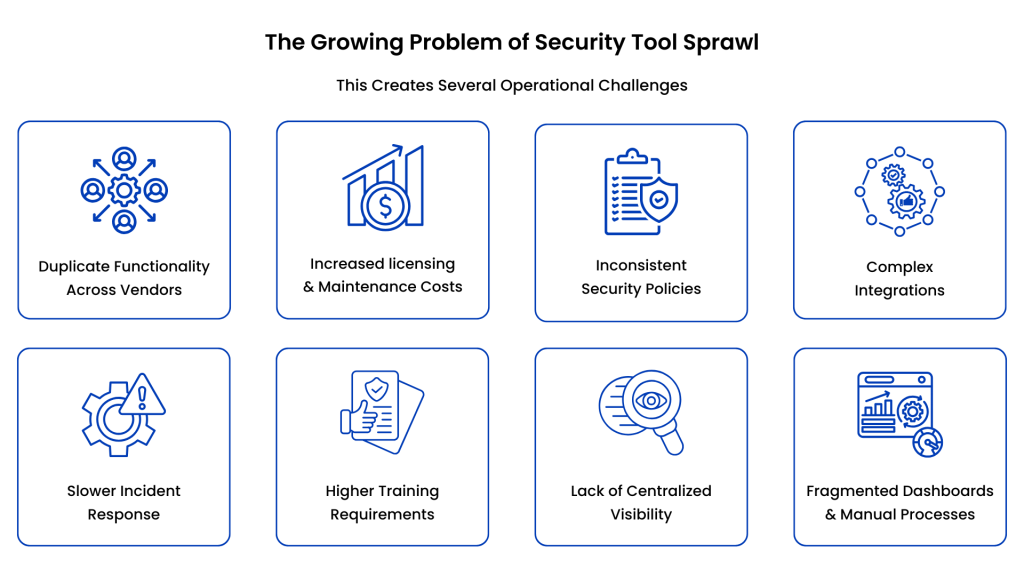
This creates several operational challenges:
- Duplicate functionality across vendors
- Increased licensing and maintenance costs
- Inconsistent security policies
- Complex integrations
- Slower incident response
- Higher training requirements
- Lack of centralized visibility
Security analysts frequently waste valuable time switching between dashboards, correlating alerts manually, and managing disconnected workflows. Instead of focusing on proactive defense, teams become overwhelmed by operational complexity.
According to recent industry reports, organizations are increasingly prioritizing consolidation because fragmented environments cannot effectively handle AI-powered attacks and rapidly evolving threat landscapes.
Why Security Consolidation Matters in 2026?
Cybersecurity threats are evolving faster than traditional security operations can respond. AI-enhanced malware, automated phishing campaigns, machine-speed attacks, and sophisticated identity threats require unified detection and rapid response capabilities.
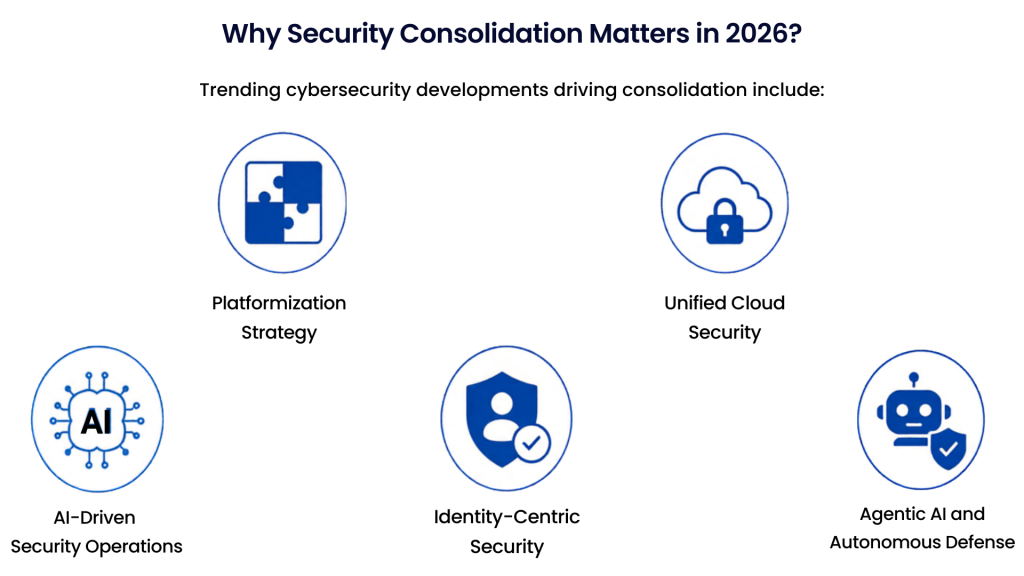
Trending cybersecurity developments driving consolidation include:
AI-Driven Security Operations
Organizations are integrating AI into Security Operations Centers (SOCs) to automate alert triage, threat correlation, and incident response workflows. AI-powered SOCs are becoming central to modern security architectures.
Platformization Strategy
Enterprises are moving from “best-of-breed” isolated tools toward integrated security platforms that combine networking, endpoint, cloud, and threat intelligence capabilities into unified ecosystems.
Identity-Centric Security
With the rise of AI agents and machine identities, organizations are focusing heavily on centralized identity governance and zero-trust frameworks.
Unified Cloud Security
As hybrid and multi-cloud adoption accelerates, businesses require centralized visibility across AWS, Azure, GCP, and on-premise environments.
Agentic AI and Autonomous Defense
Security vendors are now deploying agentic AI systems capable of autonomous investigations, threat hunting, and remediation workflows.
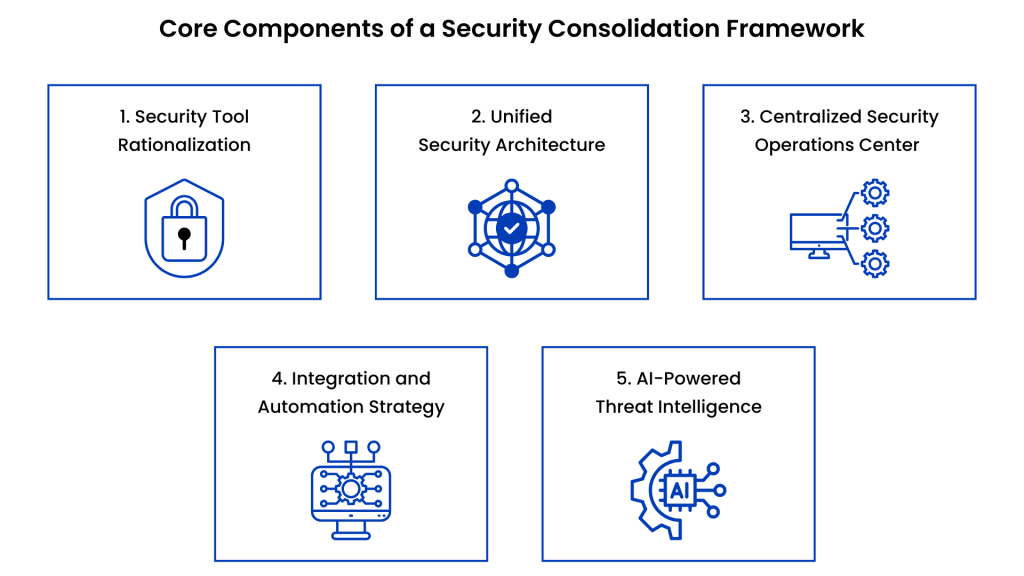
Core Components of a Security Consolidation Framework
A successful consolidation framework focuses on simplifying architecture while improving operational efficiency and resilience.
1. Security Tool Rationalization
The first step is identifying overlapping technologies and eliminating redundant tools.
Organizations should evaluate:
- Which tools provide duplicate functionality?
- Which platforms are underutilized?
- Which solutions integrate effectively?
- Which vendors support long-term scalability?
Tool rationalization reduces operational overhead and licensing expenses while improving manageability.
Key Benefits
- Lower procurement costs
- Simplified administration
- Reduced integration complexity
- Faster onboarding and training
- Improved operational visibility
2. Unified Security Architecture
Modern consolidation strategies focus on building centralized ecosystems rather than isolated deployments.
A unified architecture typically integrates:
- Endpoint security
- Network security
- SIEM and SOAR
- Identity and access management
- Cloud security posture management
- Threat intelligence platforms
- Vulnerability management
This creates a centralized operational environment with shared telemetry and synchronized workflows.
3. Centralized Security Operations Center (SOC)
Organizations are moving toward unified SOC platforms capable of correlating events across all infrastructure layers.
Modern SOC consolidation includes:
- Single-pane-of-glass monitoring
- AI-driven threat detection
- Automated response orchestration
- Centralized analytics
- Real-time incident visibility
Leading security platforms are increasingly integrating SIEM, SOAR, endpoint detection, and threat intelligence into unified operational environments.
4. Integration and Automation Strategy
Security consolidation is not simply about removing tools. It is about improving interoperability and automation.
Successful frameworks prioritize:
- API-driven integrations
- Automated workflows
- Cross-platform telemetry sharing
- Unified policy management
- Automated compliance reporting
Automation significantly reduces manual workloads and accelerates incident response times.
5. AI-Powered Threat Intelligence
Modern threat landscapes require predictive and adaptive defense systems.
AI-powered consolidation frameworks help organizations:
- Detect anomalies faster
- Correlate threats across environments
- Reduce false positives
- Improve response accuracy
- Enable predictive risk analysis
Industry experts emphasize that fragmented systems struggle to keep pace with AI-driven attacks, making centralized AI-assisted security operations increasingly critical.
Financial Impact of Security Consolidation
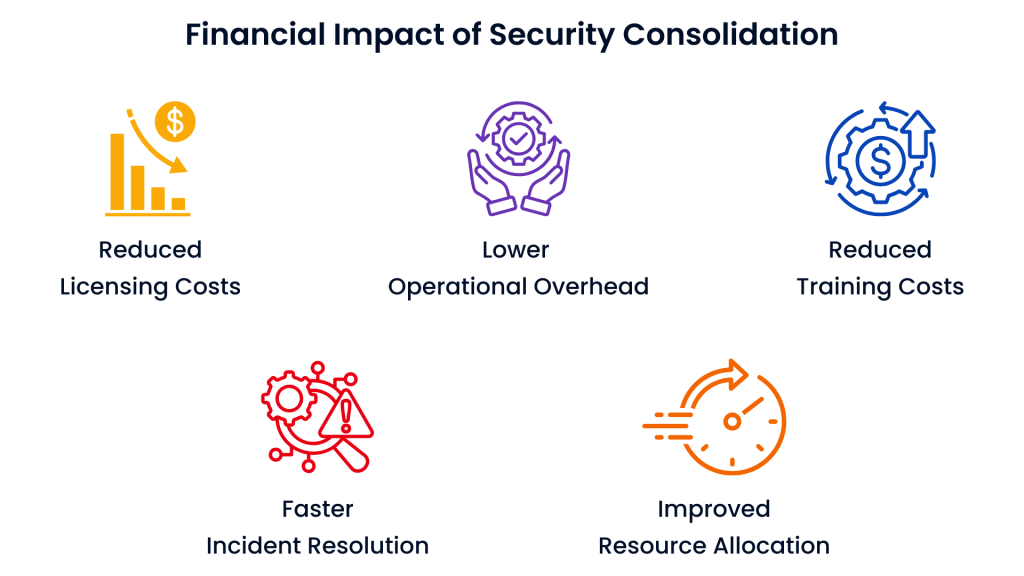
One of the strongest drivers behind consolidation is cost optimization.
Areas of Financial Savings
Reduced Licensing Costs
Eliminating redundant vendors decreases recurring subscription expenses.
Lower Operational Overhead
Simplified infrastructures require fewer administrative resources.
Reduced Training Costs
Teams only need expertise in fewer platforms.
Improved Resource Allocation
Security teams spend less time managing tools and more time mitigating threats.
Faster Incident Resolution
Integrated systems reduce downtime and business disruption costs.
Operational Efficiency Improvements
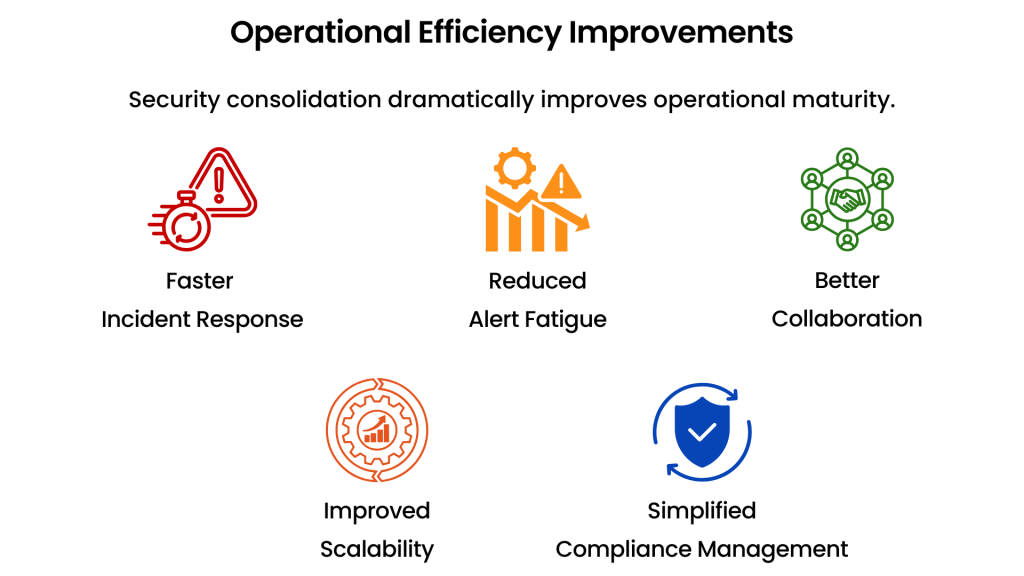
Security consolidation dramatically improves operational maturity.
Faster Incident Response
Unified visibility enables quicker threat detection and remediation.
Reduced Alert Fatigue
Centralized analytics reduce duplicate alerts and noise.
Better Collaboration
Integrated platforms improve communication between SOC, IT, compliance, and cloud teams.
Simplified Compliance Management
Centralized reporting simplifies audits and regulatory requirements.
Improved Scalability
Unified systems are easier to expand as organizations grow.
Challenges of Security Consolidation
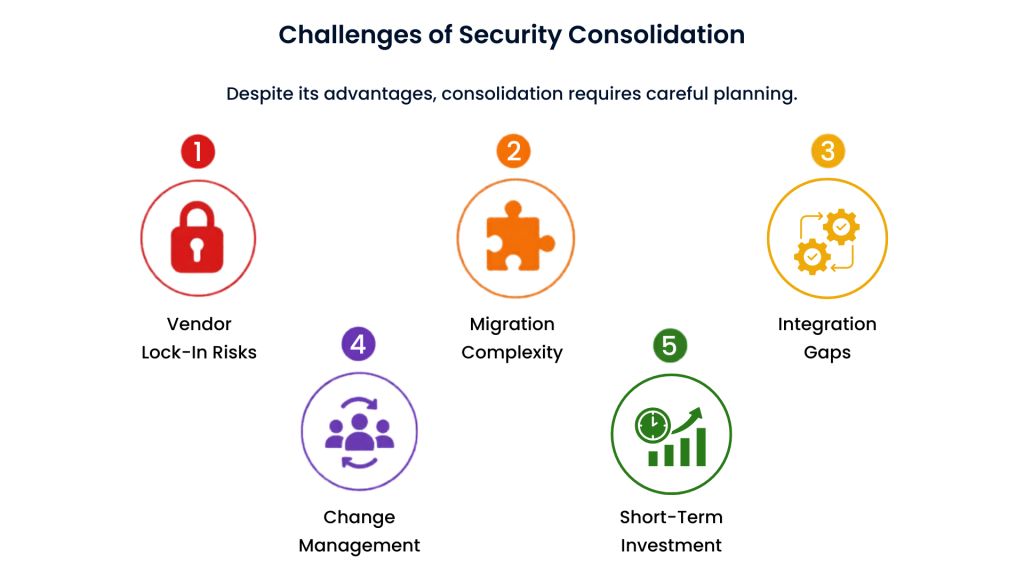
Despite its advantages, consolidation requires careful planning.
Vendor Lock-In Risks
Relying too heavily on a single vendor may reduce flexibility.
Migration Complexity
Replacing legacy systems can disrupt operations if poorly executed.
Integration Gaps
Not all platforms integrate seamlessly with existing infrastructure.
Change Management
Teams may resist operational changes and new workflows.
Short-Term Investment
Initial migration and modernization costs can be substantial.
Organizations should balance consolidation with strategic flexibility to avoid overdependence on a single ecosystem.
Best Practices for Implementing a Consolidation Framework
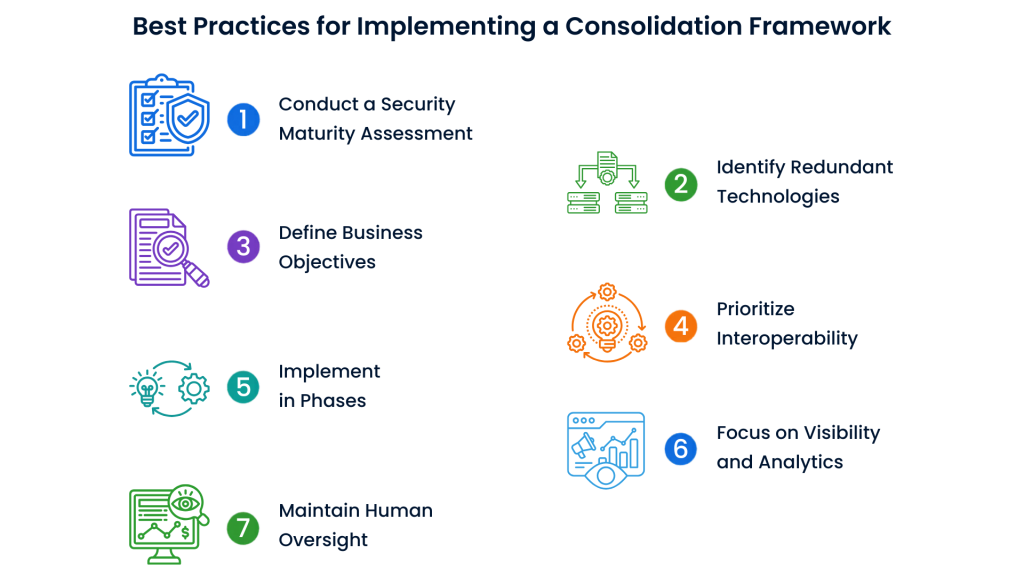
Conduct a Security Maturity Assessment
Evaluate current architecture, workflows, and operational gaps.
Identify Redundant Technologies
Map overlapping solutions and prioritize consolidation opportunities.
Define Business Objectives
Align security modernization with operational and financial goals.
Prioritize Interoperability
Select platforms with strong API and automation capabilities.
Implement in Phases
Gradual consolidation minimizes operational disruption.
Focus on Visibility and Analytics
Centralized telemetry is essential for effective threat management.
Maintain Human Oversight
AI-driven systems should enhance — not replace — security expertise.
The Future of Security Consolidation
The cybersecurity industry is rapidly transitioning toward platform-centric security models powered by AI, automation, and unified analytics.
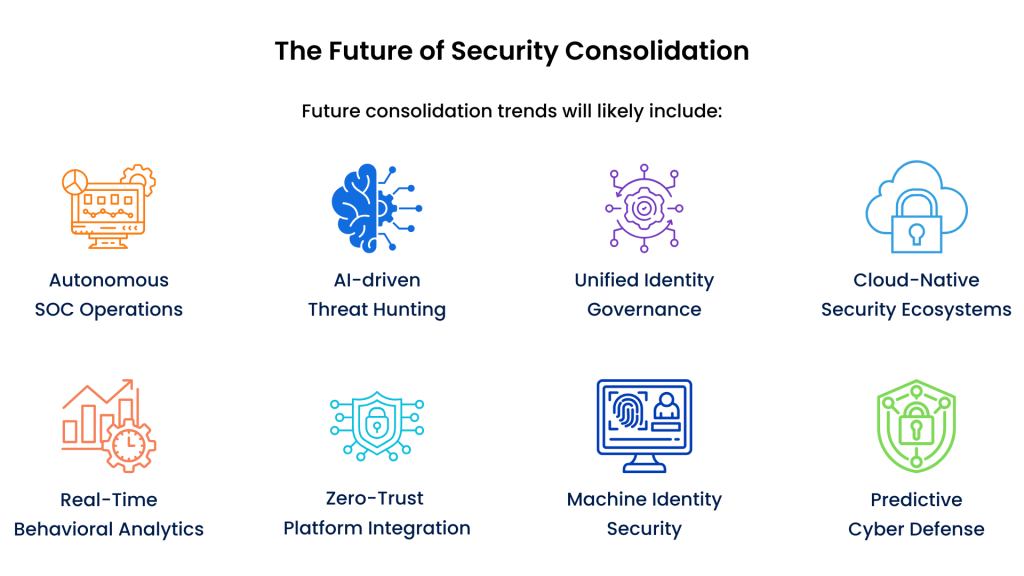
Future consolidation trends will likely include:
- Autonomous SOC operations
- AI-driven threat hunting
- Unified identity governance
- Cloud-native security ecosystems
- Real-time behavioral analytics
- Zero-trust platform integration
- Machine identity security
- Predictive cyber defense
Industry analysts predict that organizations unable to simplify and modernize their security operations may struggle to defend against increasingly automated and adaptive cyber threats.
Conclusion
Security consolidation is no longer simply a cost-reduction initiative. It has become a strategic necessity for organizations facing growing cyber complexity, AI-powered attacks, and operational inefficiencies.
A well-designed Security Consolidation Framework enables businesses to reduce tool sprawl, strengthen visibility, improve incident response, simplify compliance, and optimize cybersecurity investments.
As enterprises continue embracing AI-powered operations, cloud-first infrastructures, and unified security architectures, organizations that prioritize consolidation will be better positioned to achieve resilience, agility, and long-term operational efficiency in an increasingly complex digital landscape.