
Privacy regulations keep multiplying and tightening. GDPR, CCPA and laws like Brazil’s LGPD (and many national PDPA laws) all require organizations to inventory, protect, govern, and be able to demonstrate control over personal data. This post explains the compliance challenges you’ll face and gives a practical, tool-mapped playbook using Oracle technologies (Data Safe, Advanced Security/TDE, OCI Vault, Audit Vault, Cloud Guard, etc.) so you can build defensible controls and faster evidence for auditors.
Why compliance is procedural not just legal?
Regulations (e.g., GDPR) apply not only to where data is stored but often to who the data is about and how you process it which is why privacy programs must be data-centric: discover → protect → govern → monitor → respond. GDPR in particular has broad, extraterritorial reach and prescribes principles such as lawfulness, purpose limitation, data-minimization and accountability.
Likewise, the CCPA gives California residents rights (access, deletion, opt-out of sale) and creates enforcement avenues that can include private actions tied to certain breach categories meaning breach prevention and demonstrable controls matter.
The top operational challenges teams face
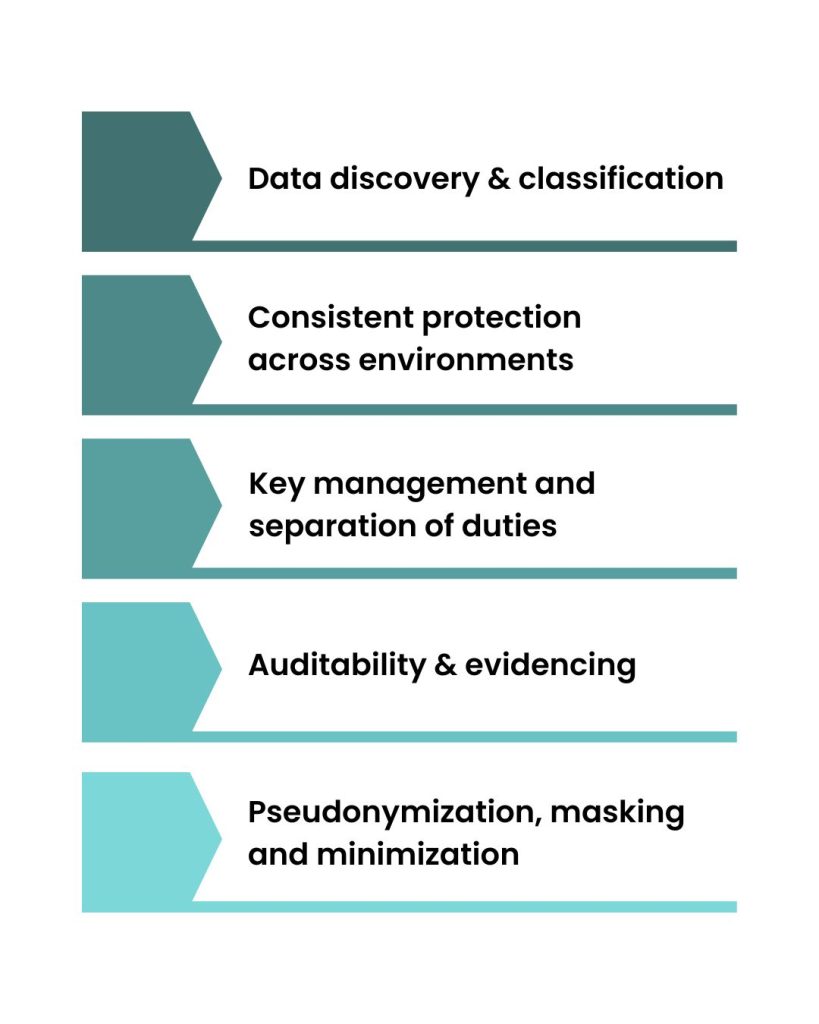
- Data discovery & classification — you can’t protect what you can’t find.
- Consistent protection across environments — production, non-prod, cloud, on-prem.
- Key management and separation of duties — encryption without proper key control is risky.
- Auditability & evidencing — auditors want trails: who accessed what, when, and why.
- Pseudonymization, masking and minimization — for analytics, testing and third-party sharing.
Oracle provides targeted tools that map to each control area; below I show how to use them together.
Oracle toolset mapped to privacy controls (what to use for what)
1) Discover & classify — Oracle Data Safe
- What it does: scans databases, identifies sensitive columns, builds a data inventory and sensitivity profile, and runs risk assessments (including privileged user risk).
- Why it matters: building an auditable inventory is step one for DPIAs, data-mapping and responding to subject access requests.
How to implement (quick steps):
- Register each database (on-prem and OCI) with Data Safe.
- Run sensitive-data discovery profiles (PHI/PII patterns, custom regexes).
- Export the inventory to your GRC platform or maintain a Data Safe report for audits.
2) Protect data at rest & in transit — Oracle Advanced Security (TDE) + OCI Vault
- Transparent Data Encryption (TDE) protects data at rest (tablespace/file encryption) and is production-grade for databases. It reduces risk of data exposure from stolen media or OS-level access.
- OCI Vault (Key Management & Secrets) provides customer-managed keys (HSM-backed) so you control key lifecycle, rotation and key separation essential for “technical and organizational measures” under GDPR.
Deployment pattern:
- Enable TDE for sensitive tablespaces.
- Use OCI Vault to host CMKs (customer-managed keys); configure database encryption keys to be wrapped by Vault keys.
- Implement strict IAM and separation of duties for key access.
3) Masking & pseudonymization — Data Masking & Sub setting / Data Safe masking
- For non-production environments or when sharing datasets with analysts/third parties, apply data masking and sub setting to remove direct identifiers while preserving analytic value. Oracle’s Data Masking pack and Data Safe masking profiles automate common pseudonymization patterns.
Practical rule: keep at least one copy of raw identifiers in a tightly controlled vaulted environment (encrypted + audited), while using masked datasets everywhere else.
4) Monitor, audit & detection — Oracle Audit Vault & Database Firewall + Data Safe activity auditing + Cloud Guard
- Audit Vault consolidates audit logs, captures SQL traffic, and helps detect suspicious queries and privilege misuse useful for breach investigation and proof of controls.
- Data Safe also captures activity auditing for database users and produces compliance-oriented reports.
- Cloud Guard monitors OCI resource misconfigurations and risky activities (useful for cloud posture visibility that supports regulatory obligations to secure processing environments).
Operational guidance:
- Centralize logs (Audit Vault + OCI Logging + SIEM).
- Define detection rules for: large exports, bulk SELECTs on sensitive columns, privilege escalations.
- Keep retention policies aligned with legal requirements (and document the retention periods in your data retention policy).
A practical compliance playbook (step-by-step)
Phase A — Prepare & map
- Data mapping: use Data Safe to inventory all sensitive columns and map them to processing activities (for DPIA).
- Risk classification: tag data by sensitivity and legal jurisdiction (EU residents, CA residents, BR residents).
Phase B — Technical controls
- Encryption: enable TDE for DBs; move key control to OCI Vault (HSM) and implement rotation policies.
- Masking & sub setting: create masked test datasets for dev/test pipelines.
Phase C — Detection & response
- Audit & monitoring: deploy Audit Vault + Data Safe auditing; configure Cloud Guard for cloud posture checks.
- Incident playbooks: predefine breach notification timelines and roles keep contact lists and sample notifications ready (GDPR: 72 hours for supervisory authority notification where required).
Phase D — Evidence & continuous compliance
- Reports & evidence: schedule Data Safe reports for auditors, export Audit Vault reports, and retain masked/non-masked dataset lineage for requests.
- Automation: shift data discovery and masking into CI pipelines so compliance is continuous, not ad hoc.
Sample privacy-controls matrix (short)
| Privacy goal | Oracle tool(s) | Outcome |
| Inventory & classification | Data Safe | Sensitive data catalog for DPIAs |
| Encrypt at rest | TDE (Advanced Security) + OCI Vault | Prevents data exposure from stolen media; customer key control |
| Mask for testing | Data Masking & sub setting / Data Safe | Pseudonymized test data |
| Monitor & collect evidence | Audit Vault, Data Safe activity logs | Auditable trails for access & anomalies |
| Cloud posture | Cloud Guard | Detect misconfigurations that increase breach risk |
(References: Oracle product pages and docs cited throughout.)
Practical tips & pitfalls (what many teams miss)
- Don’t treat encryption as “done” — without key management and access controls, encryption offers little audit value. Keep keys out of application code and use OCI Vault.
- Mask early — incorporate masking/sub setting in your deploy pipeline so developers never touch production identifiers.
- Map legal obligations to tech controls — for example: a right-to-erasure request must be tied to a process that identifies all data stores (so discovery + automated deletion processes are essential).
- Retention policies are both legal and technical — automate deletion or archival workflows and record the evidence.
Example architecture (high level)
- Source systems → databases registered to Data Safe for classification.
- Sensitive columns → protected with TDE (DB encryption) and keys in OCI Vault.
- Non-prod pipelines use masked subsets produced by Data Masking.
- Audit Vault ingests DB audit logs and SQL traffic; Cloud Guard monitors OCI config.
- Central SIEM collects logs + alerts; compliance reports exported on demand.
Wrapping up — compliance as an engineering discipline
Regulation compliance is durable only when it’s embedded into engineering not treated as an annual checklist. Oracle’s suite (Data Safe, Advanced Security/TDE, Vault, Audit Vault, Cloud Guard) gives you the building blocks to operationalize discovery, protection, and auditability. Use discovery to create the inventory, enforcement (encryption/masking) to reduce exposure, and monitoring/audit to prove you did what the law expects. The result: faster subject request handling, lower breach risk, and stronger audit posture.