

Introduction: The Hidden Cost of “Getting Cloud Wrong”
Cloud adoption is often positioned as a driver of agility, innovation, and cost efficiency. But when cloud strategy drifts away from business objectives, organizations don’t just lose efficiency—they create systemic risk.
Cloud misalignment isn’t a technical issue. It’s a business problem.
It shows up as:
- Unexpected costs
- Compliance failures
- Limited visibility for decision-making
- Blurred ownership
Over time, these issues compound into measurable financial and operational damage.
1. Financial Leakage from Poor Cloud Decisions
The Illusion of Cost Efficiency
Cloud promises pay-as-you-go efficiency. But without alignment to business needs, spending becomes fragmented and difficult to control.
Where Financial Leakage Happens
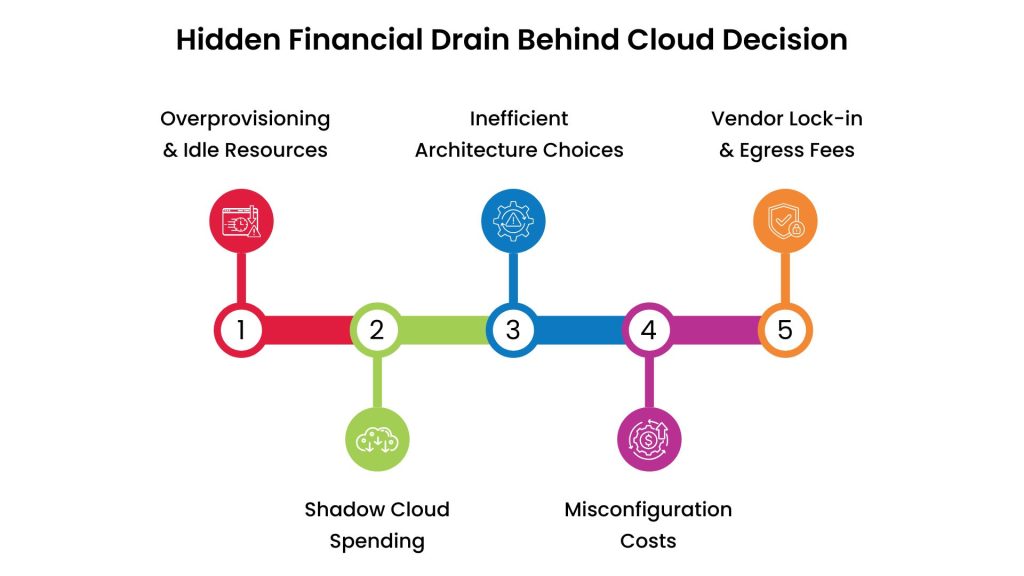
1. Overprovisioning & Idle Resources
Teams deploy more than required “just in case,” leading to unused compute, storage, and licenses.
2. Shadow Cloud Spending
Departments independently adopt tools without centralized oversight, duplicating costs.
3. Inefficient Architecture Choices
Using premium services where simpler alternatives would suffice increases long-term cost burden.
4. Misconfiguration Costs
Poor configurations lead to breaches, downtime, and expensive remediation.
- The average cost of a data breach has reached ~$4.88 million globally
5. Vendor Lock-in & Egress Fees
Lack of strategic planning traps organizations in costly ecosystems.
Business Impact
- Budget unpredictability
- Reduced ROI on cloud investments
- Funds diverted from innovation to operational firefighting
2. Compliance Exposure and Regulatory Risk
The Misunderstanding: “The Cloud Provider Handles Security”
One of the biggest drivers of cloud misalignment is a misunderstanding of the shared responsibility model.
Organizations remain responsible for:
- Data protection
- Access control
- Configuration
How Misalignment Creates Compliance Risk

1. Misconfigured Storage & Access
Publicly exposed data remains one of the most common risks.
2. Weak Identity & Access Management (IAM)
Over-permissive access increases the likelihood of unauthorized exposure.
3. Lack of Encryption & Logging
Failure to enforce these controls can directly violate regulatory requirements.
4. Multi-Region Data Issues
Improper data residency decisions can breach data sovereignty laws.
Consequences
- Regulatory fines (e.g., GDPR penalties up to 4% of revenue)
- Legal liability
- Operational restrictions and audits
Business Reality
Compliance failures are rarely due to a lack of tools—they stem from misalignment between cloud operations and regulatory requirements.
3. Data Visibility Challenges
The Core Problem: You Can’t Manage What You Can’t See
As organizations scale across multi-cloud and hybrid environments, visibility begins to break down.
Where Visibility Fails
1. Fragmented Data Across Platforms
Different teams use different cloud services with no unified view.
2. Lack of Central Monitoring
No single source of truth for security, cost, or usage.
3. Unknown Data Exposure
Organizations often don’t know:
- What data exists
- Where it is stored
- Who has access
Misconfigurations can expose sensitive data without detection for extended periods.
4. Shadow SaaS Growth
Unapproved applications create blind spots in data governance.
Business Impact
- Poor decision-making due to incomplete data
- Increased breach risk
- Delayed incident detection and response
4. Cloud Accountability Gaps
The Ownership Problem
In traditional IT, ownership was clearer. In cloud environments, responsibility becomes distributed—and often unclear.
Where Accountability Breaks
1. Dev vs Security vs Operations Misalignment
- Dev teams prioritize speed
- Security teams prioritize control
- Operations teams focus on uptime
Without alignment, gaps emerge.
2. Lack of Defined Ownership
Who owns:
- Cloud costs?
- Security posture?
- Data governance?
Too often, no one fully does.
3. Decentralized Decision-Making
Teams independently deploy services without governance.
4. Temporary Exceptions Becoming Permanent
Short-term shortcuts evolve into long-term risks.
Real-World Pattern
Many cloud risks are not caused by sophisticated attacks—but by simple human errors and misconfigurations.
Business Impact
- Increased operational risk
- Slow incident response
- Lack of accountability during failures
5. Aligning Cloud Strategy with Business Objectives
The Core Shift: From Technology-Led to Business-Led Cloud
Cloud must serve business outcomes—not the other way around.
Key Alignment Principles
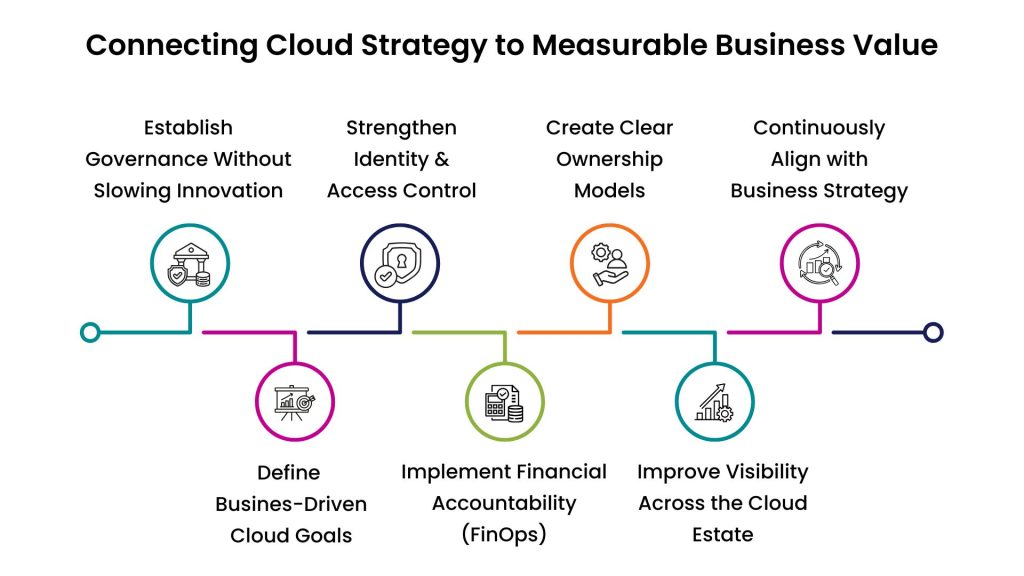
1. Define Business-Driven Cloud Goals
- Cost optimization
- Speed to market
- Customer experience
- Regulatory compliance
Every cloud decision should map to these outcomes.
2. Establish Governance Without Slowing Innovation
- Standardized architectures
- Policy-as-code
- Automated compliance checks
Balance control with agility.
3. Implement Financial Accountability (FinOps)
- Track cost per team or product
- Introduce chargeback or showback models
- Continuously optimize usage
4. Strengthen Identity & Access Control
- Enforce least privilege
- Continuous authentication
- Apply Zero Trust principles
5. Improve Visibility Across the Cloud Estate
- Centralized dashboards
- Real-time monitoring
- Data classification and tracking
6. Create Clear Ownership Models
Define accountability for:
- Security
- Cost
- Data
- Infrastructure
No shared responsibility without clear ownership.
7. Continuously Align with Business Strategy
Cloud environments evolve rapidly.
Alignment must be continuous—not a one-time effort.
Conclusion: Cloud Misalignment Is a Silent Business Risk
Cloud misalignment doesn’t fail loudly—it fails quietly.
- Costs gradually increase
- Risks accumulate unnoticed
- Visibility declines
- Accountability weakens
By the time issues surface, the impact is already significant.
The organizations that succeed in the cloud are not the ones that adopt it fastest—
they are the ones that align it most effectively with business priorities.
Final Thought
Cloud is not just infrastructure.
It is a business operating model.
And like any operating model,
misalignment doesn’t just reduce efficiency—it creates risk.