Introduction: The Cloud Paradox
Cloud adoption has fundamentally transformed how organizations build, scale, and operate technology. It promised speed, flexibility, and innovation—and in many ways, it delivered.
But alongside this acceleration came a less visible consequence: a gradual erosion of control.
As cloud environments expand, enterprises increasingly face a structural paradox:
- Move fast → risk losing visibility and governance
- Tighten controls → risk slowing innovation and agility
This is no longer a technology challenge—it is an operating model challenge.
The question is not whether to use the cloud, but how to control it without constraining it.
This is where a Cloud Control Model becomes essential.
What is a Cloud Control Model?
A Cloud Control Model is a structured, enterprise-wide framework that defines how cloud environments are:
- Governed
- Monitored
- Secured
- Optimized
- Aligned with business objectives
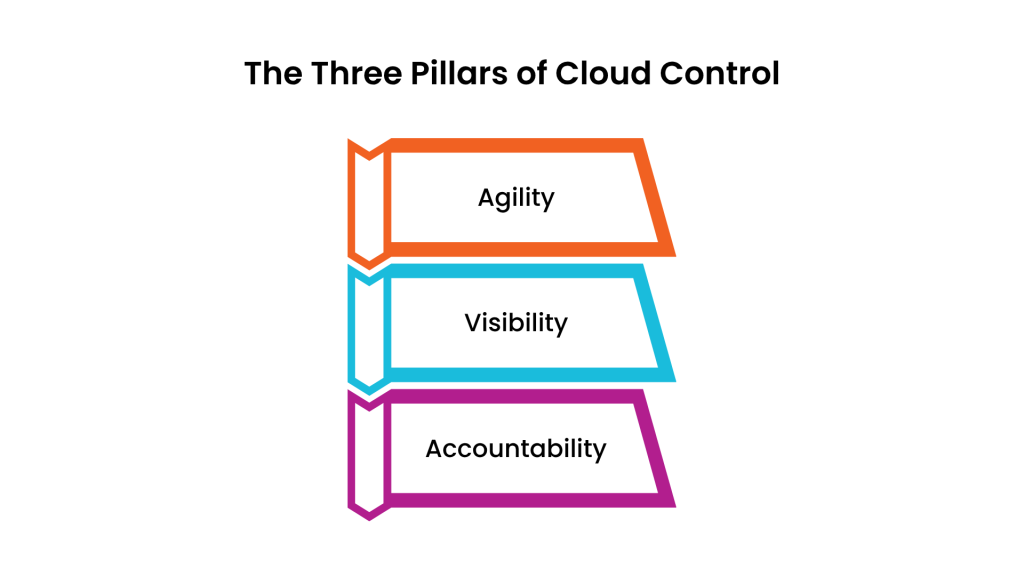
It ensures three critical outcomes:
- Agility for delivery teams
- Visibility for leadership
- Accountability across functions
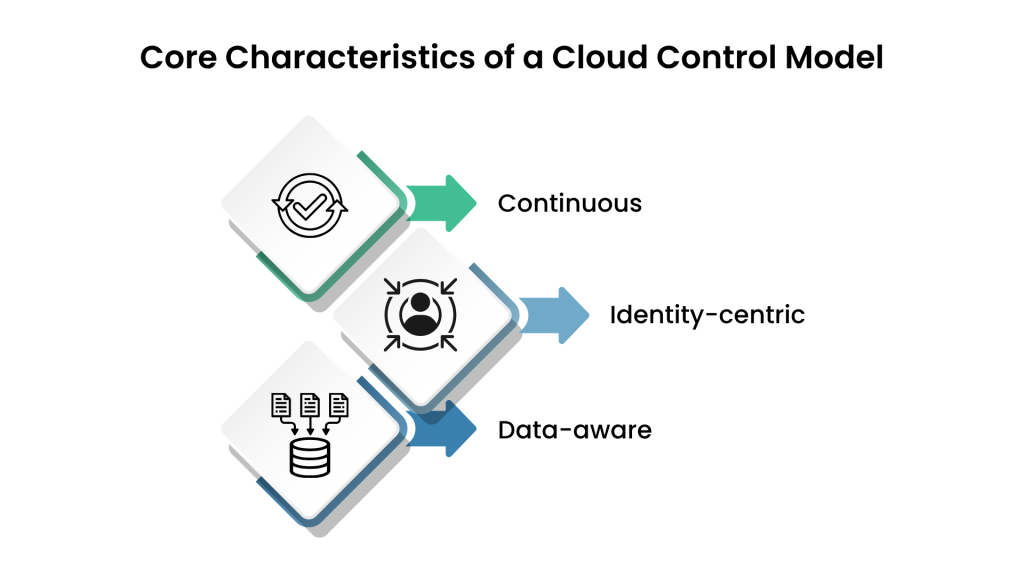
Unlike traditional IT governance, which relied on static controls and periodic reviews, cloud environments require a model that is:
- Continuous – Controls operate in real time, not after deployment
- Identity-centric – Access decisions are based on identity, not network location
- Data-aware – Governance focuses on data movement and usage, not just infrastructure
This shift reflects a broader reality: cloud is not just infrastructure—it is a dynamic business platform.
The Three Pillars of Cloud Control
1. Agility: Enabling Speed Without Chaos
Agility is the primary reason organizations adopt cloud. It enables:
- Faster product releases
- Rapid experimentation
- On-demand scalability
However, without governance, agility becomes uncontrolled expansion.
Common outcomes of unmanaged agility include:
- Shadow IT and unapproved SaaS adoption
- Inconsistent deployment patterns
- Security and compliance gaps introduced during rapid changes
A mature Cloud Control Model does not restrict agility—it structures it.
This is achieved through:
- Standardized, reusable architectures
- Policy-as-code embedded into deployment pipelines
- Self-service environments with predefined guardrails
- Automation that enforces compliance without manual intervention
The objective is not to slow teams down, but to ensure that speed operates within a controlled framework.
Agility, when guided correctly, becomes scalable rather than chaotic.
2. Visibility: Creating a Single Source of Truth
Visibility is the foundation of control.
Without a clear understanding of what exists in the environment, governance becomes reactive and incomplete.
In modern cloud environments, visibility challenges arise due to:
- Multi-cloud and hybrid architectures
- Rapid provisioning and de-provisioning of resources
- Decentralized ownership across teams
- Growth of SaaS ecosystems outside traditional IT oversight
These conditions lead to:
- Unknown assets and configurations
- Blind spots in security monitoring
- Difficulty tracking data movement and access
- Inaccurate or delayed decision-making
A robust visibility framework addresses these gaps by providing:
- Unified asset inventory across all environments
- Real-time monitoring of infrastructure, applications, and identities
- Data discovery and classification to track sensitive information
- Access visibility to understand who is interacting with what
The goal is to create a single, consistent view of the cloud environment, enabling proactive control rather than reactive response.
Visibility transforms fragmented data into actionable insight.
3. Accountability: Establishing Clear Ownership
In traditional IT environments, ownership was often centralized and well-defined.
In cloud environments, responsibility becomes distributed—and often unclear if not intentionally structured.
This lack of clarity leads to critical gaps:
- Security controls left unassigned
- Cost overruns without clear ownership
- Delayed response during incidents
- Governance responsibilities falling between teams
A strong Cloud Control Model enforces accountability through:
- Clearly defined ownership structures (such as RACI models)
- Role-based access control aligned with responsibilities
- End-to-end auditability of actions and decisions
- Alignment between business ownership and technical ownership
Accountability ensures that:
- Every resource has an owner
- Every action is traceable
- Every risk has a responsible party
Without accountability, visibility does not translate into control.
Cloud Operating Model: The Foundation Layer
A Cloud Control Model is only effective when supported by a well-defined Cloud Operating Model.
This operating model determines how cloud decisions are made, implemented, and governed across the organization.
Organizational Structure
- A central governance function sets policies and standards
- Decentralized teams execute within defined boundaries
- Clear escalation and decision-making pathways are established
Process Framework
- Provisioning processes aligned with automation and speed
- Change management adapted to continuous deployment models
- Incident response designed for distributed, dynamic environments
Technology Enablement
- Cloud management platforms for centralized control
- Security posture management tools for continuous compliance
- Cost management solutions for financial governance
The operating model ensures that control is not theoretical—it is embedded into daily operations.
Identity-Centric Architecture: The New Control Plane
Cloud fundamentally changes the security perimeter.
In traditional environments, control was enforced at the network level.
In cloud environments, identity becomes the primary control point.
This shift is driven by:
- Remote and distributed access patterns
- Service-to-service communication across platforms
- Autonomous machine identities (APIs, bots, workloads)
An identity-centric architecture focuses on:
- Strong identity providers and authentication systems
- Multi-factor authentication across all access points
- Least-privilege access enforcement
- Continuous verification of identity and behavior
The strategic shift is clear:
From trusting location → to validating identity continuously.
This approach aligns with modern security principles such as Zero Trust, where no access is assumed to be safe without verification.
Building a Visibility Framework
Effective visibility goes beyond monitoring—it provides context, correlation, and clarity.
Key Layers of Visibility
Infrastructure Layer
Tracks compute, storage, containers, and serverless resources
Application Layer
Monitors performance, dependencies, and service interactions
Data Layer
Provides insight into data location, movement, and access
Identity Layer
Tracks access patterns, privilege usage, and anomalies
Business Outcomes
- Faster detection of incidents and misconfigurations
- Stronger regulatory compliance
- Improved operational and strategic decision-making
Visibility is what enables organizations to move from awareness to control.
Cost + Control Alignment: FinOps Meets Governance
Cloud spending is often the first visible symptom of poor control.
However, cost issues are rarely just financial—they are operational and governance issues.
Common challenges include:
- Overprovisioned and underutilized resources
- Lack of cost attribution across teams
- Uncontrolled SaaS adoption
- Inefficient architectural decisions
Integrating cost management into the control model requires:
- Tagging and attribution frameworks to link spend to business units
- Budget controls and automated alerts to prevent overruns
- Continuous optimization practices to eliminate waste
- Policy enforcement to prevent non-compliant deployments
Cost control becomes effective only when it is embedded into how cloud is designed and operated.
The objective is to ensure that every unit of spend aligns with business value.
Strategic Roadmap for Enterprises
Building a Cloud Control Model is an evolving journey.
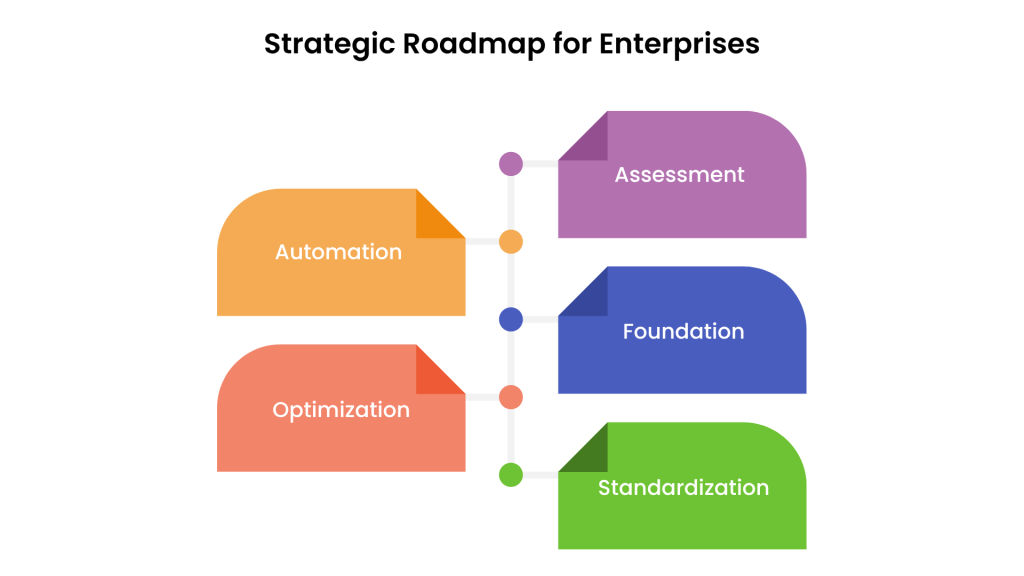
Phase 1: Assessment
- Identify all cloud assets and services
- Evaluate current visibility and governance gaps
- Assess organizational maturity
Phase 2: Foundation
- Define the cloud operating model
- Establish identity and access controls
- Implement baseline monitoring and visibility
Phase 3: Standardization
- Introduce policy-as-code frameworks
- Standardize deployment patterns
- Enforce tagging and governance standards
Phase 4: Automation
- Automate compliance and security checks
- Enable controlled self-service
- Integrate monitoring with response mechanisms
Phase 5: Optimization
- Continuous cost and performance optimization
- Advanced analytics and predictive insights
- Adaptive and intelligence-driven security models
Organizations mature by moving from:
Reactive control → Proactive governance → Predictive and adaptive control.
Common Pitfalls to Avoid
Even well-designed strategies can fail due to execution gaps:
- Over-centralized governance that slows innovation
- Lack of executive alignment and sponsorship
- Treating identity as secondary rather than foundational
- Implementing tools without a clear strategy
- Disconnect between finance, security, and operations
Avoiding these pitfalls is essential to sustaining long-term control.
Conclusion: Control Enables Sustainable Agility
A common misconception in cloud strategy is that control limits speed.
In reality, the opposite is true.
Without control:
- Risks accumulate
- Costs increase
- Visibility decreases
- Decision-making weakens
With the right control model:
- Teams move faster with confidence
- Leaders operate with clarity
- Risks are managed proactively
The goal is not to choose between agility and control, but to design both into the system.
Final Thought
Cloud maturity is not defined by how fast an organization moves— but by how effectively it maintains control while moving fast.