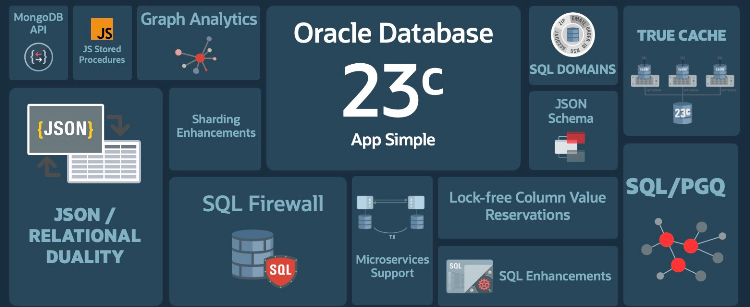
Oracle Database 23c, also known as “App Simple”, is a game-changing release that addresses the evolving demands of modern applications, data management, and developer productivity. As the foundation of Oracle’s converged database strategy, 23c introduces several innovations designed to simplify application development, improve performance, enhance security, and extend multi-model capabilities.
In this post, we’ll explore the key new features and enhancements in Oracle Database 23c that make it one of the most powerful and future-ready databases available today.
1. JSON Relational Duality – The Best of Both Worlds
One of the most groundbreaking features in Oracle 23c is JSON Relational Duality, which enables developers to access the same data as both relational tables and JSON documents—without data duplication.
Why it matters:
- Facilitates schema flexibility for developers.
- Retains ACID compliance and relational integrity.
- Simplifies integration between modern applications and legacy systems.
This duality approach allows developers to build applications using familiar document paradigms while benefiting from relational strengths in scalability, consistency, and analytics.
2. Operational Property Graphs – Native Graph Model Support
Oracle Database 23c introduces native property graph support that lets users store, query, and analyze highly connected data using PGQL (Property Graph Query Language).
Key benefits:
- Native graph data model inside the database.
- Improved performance for connected data use cases (e.g., fraud detection, social networks).
- Enables hybrid queries combining SQL and graph analytics.
Operational property graphs make Oracle a true multi-model database, suitable for complex and dynamic data relationships.
3. SQL Enhancements – Simpler, More Powerful Querying
Oracle continues to refine SQL usability with several syntax enhancements and new capabilities, including:
- SELECT without FROM clause – Simplifies queries returning expressions or constants.
- Boolean data type – Native support for
TRUE,FALSE, andUNKNOWN. - IF [NOT] EXISTS/IF [NOT] DEFINED – Conditional DDL statements for safer deployments.
- Anonymous Blocks in SQL Scripts – Improved PL/SQL scripting capabilities.
- Improved MERGE and RETURNING syntax – More intuitive and developer-friendly.
These enhancements improve developer efficiency, reduce code complexity, and support DevOps-friendly CI/CD practices.
4. JSON Schema and JSON Relational Integration
Oracle 23c supports JSON Schema standard validation natively, allowing developers to enforce structure and constraints directly within JSON data.
Why this matters:
- Increases data quality and consistency in document-style data.
- Supports schema evolution, making it easier to adapt to application changes.
- Enables rich querying via SQL or JSONPath syntax.
This feature brings the rigor of relational modeling to document stores—without compromising flexibility.
5. AI Vector Search – Powering Intelligent Applications
To meet the demand for AI-powered search and retrieval, Oracle Database 23c includes Vector Search support for high-dimensional data.
Key use cases:
- Natural language processing (NLP)
- Image and audio recognition
- Recommendation engines
- Generative AI model integration
By supporting vector embeddings, Oracle enables the development of intelligent applications that can search and rank data based on semantic meaning, not just keyword matches.
6. Simplified Application Development with APEX and REST
Oracle 23c enhances Oracle APEX (low-code application platform) and REST Data Services (ORDS) by integrating them more deeply into the database.
Key features:
- Declarative APIs for quick RESTful service creation.
- Seamless support for JSON-relational integration.
- Improved support for mobile-first and web application development.
This accelerates the build-test-deploy lifecycle, helping organizations deliver applications faster with minimal infrastructure overhead.
7. Enhanced Security and Compliance
Oracle 23c introduces several important security enhancements, including:
- SQL Firewall – Blocks unauthorized or anomalous SQL queries based on a whitelist.
- Data Redaction Improvements – More flexible and conditional data masking.
- Stronger encryption algorithms – Improved compliance with modern regulatory standards.
- Fine-Grained Auditing Enhancements – Granular visibility and control for sensitive data access.
These features reinforce Oracle’s position as a security-first platform trusted by global enterprises.
8. Automatic Storage and Indexing Improvements
Oracle Database 23c continues the automation journey with enhanced capabilities in:
- Automatic Indexing – Now supports more use cases with improved transparency and control.
- Automatic Storage Management (ASM) – Better handling of mixed workloads and hybrid environments.
This ensures self-optimizing performance with reduced DBA effort, ideal for cloud-native and hybrid cloud deployments.
9. Converged Database Capabilities Extended
Oracle 23c further strengthens its converged database vision by seamlessly supporting:
- Relational, JSON, XML, spatial, graph, and text data models.
- Real-time analytics, OLTP, and machine learning in a single engine.
- Multi-tenant architecture with improved isolation and manageability.
This eliminates the need for fragmented data stacks, helping organizations consolidate infrastructure and lower total cost of ownership.
Final Thoughts
Oracle Database 23c is a powerful leap forward in database innovation, offering a modern, developer-centric platform without compromising on enterprise-grade performance, security, and reliability. Whether you’re building AI-driven apps, managing complex data relationships, or modernizing legacy systems, Oracle 23c delivers the tools and flexibility needed for today’s dynamic workloads.
FAQs
Q1: Is Oracle 23c available for production use?
A: As of the latest release notes, Oracle Database 23c is available for general use under the Oracle Free – Developer Release, with planned full commercial availability soon. Stay updated through official Oracle announcements.
Q2: How does 23c improve developer productivity?
A: By supporting modern development patterns (e.g., JSON, REST, boolean types), reducing boilerplate code, and automating routine operations, 23c empowers developers to focus on business logic and innovation.
Q3: Can Oracle 23c be used in cloud environments?
A: Yes, Oracle 23c is designed for hybrid and multi-cloud deployments and will be available on Oracle Cloud Infrastructure (OCI), Exadata, and on-premises.