

Technology debt is not a technical issue. It’s a financial one.
Most organizations treat technology debt as an engineering inconvenience—something the IT team will eventually clean up when time allows. But the reality is far more serious. Technology debt quietly drains financial resources, slows innovation, increases risk exposure, and weakens an organization’s long-term competitiveness.
In today’s digital economy, where businesses rely heavily on cloud platforms, SaaS ecosystems, legacy infrastructure, and cybersecurity frameworks, unmanaged technology debt becomes a structural financial burden. What may have started as a quick workaround to meet a deadline or reduce short-term costs often evolves into a long-term operational liability.
For business leaders and executives, technology debt is not just an IT concern—it is a strategic financial issue that directly impacts profitability, agility, and growth.
Understanding Technology Debt
Technology debt (often called technical debt) occurs when organizations choose faster, cheaper, or temporary solutions instead of optimal long-term system architecture. These decisions may initially help teams move quickly, launch products faster, or meet immediate business demands.
However, over time these shortcuts accumulate.
Outdated systems, fragmented platforms, redundant tools, legacy codebases, and poorly integrated applications begin to create complexity. The organization then spends more time maintaining systems than improving them.
This accumulated complexity becomes technology debt.
Like financial debt, it comes with interest. The longer it remains unresolved, the more expensive it becomes.
1. The Maintenance Cost Spiral
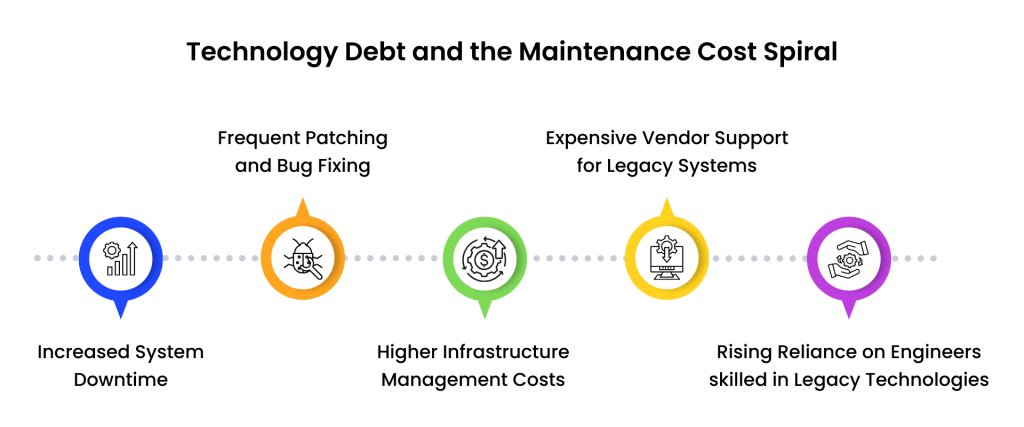
One of the most visible financial impacts of technology debt is the maintenance cost spiral.
As systems age and architectures become more complex, organizations are forced to allocate a growing portion of their IT budgets simply to keep systems operational. Instead of investing in innovation or modernization, resources are spent on patching vulnerabilities, fixing integrations, and maintaining outdated infrastructure.
Common symptoms include:
• Increased system downtime
• Frequent patching and bug fixing
• Higher infrastructure management costs
• Expensive vendor support for legacy systems
• Rising reliance on engineers skilled in legacy technologies.
In many enterprises, 60–80% of the IT budget is consumed by maintenance activities, leaving only a small portion available for transformation initiatives.
This maintenance-heavy spending pattern traps organizations in a cycle where the cost of maintaining the past outweighs the investment in the future.
2. Innovation Slowdown
Technology debt directly impacts an organization’s ability to innovate.
When development teams must navigate outdated systems, complex integrations, and rigid architectures, launching new products or features becomes slower and more difficult.
Instead of building new capabilities, engineers spend valuable time dealing with:
• Legacy system limitations
• Compatibility issues between platforms
• Workarounds for outdated infrastructure
• Manual processes that should be automated

This significantly increases development timelines.
What could have taken weeks may take months.
In highly competitive markets, this delay can have serious consequences. Competitors that operate on modern, scalable platforms can release updates faster, respond to customer needs more quickly, and adapt to changing market conditions.
Technology debt therefore becomes an innovation tax—a hidden cost that slows the organization’s ability to evolve.
3. Budget Leakage Across the Enterprise
Another financial impact of technology debt is budget leakage.
When systems are fragmented and poorly integrated, departments often adopt their own solutions to fill capability gaps. Marketing may purchase separate SaaS tools, finance may use independent data systems, and operations may implement standalone platforms.
While each decision may seem reasonable in isolation, collectively these create an expensive ecosystem of redundant tools and disconnected data sources.
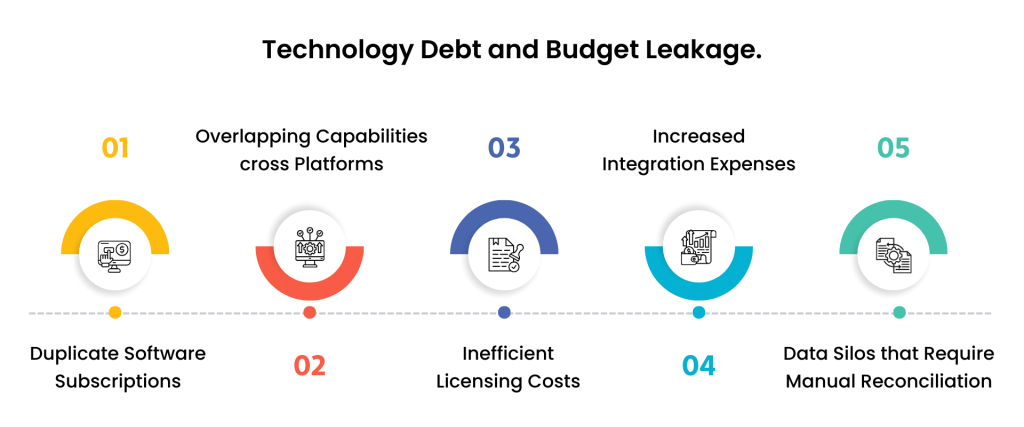
This fragmentation leads to:
• Duplicate software subscriptions
• Overlapping capabilities across platforms
• Inefficient licensing costs
• Increased integration expenses
• Data silos that require manual reconciliation
The result is a continuous drain on operational budgets without delivering proportional business value.
Organizations often underestimate how much technology debt contributes to this hidden financial leakage.
4. Increased Risk Exposure
Technology debt also increases organizational risk exposure.
Legacy systems and outdated architectures are more vulnerable to security breaches, compliance failures, and operational disruptions.
Older systems may lack modern security protocols, receive fewer updates from vendors, or rely on unsupported technologies. Integrating them with modern applications often requires complex workarounds that introduce new vulnerabilities.
These risks manifest in several ways:
• Cybersecurity vulnerabilities
• Regulatory compliance challenges
• Data governance issues
• Increased downtime and system failures
• Disaster recovery limitations

When technology debt leads to system outages or security incidents, the financial consequences can be severe—ranging from regulatory fines to reputational damage and lost customer trust.
In this context, technology debt becomes a risk multiplier for the entire organization.
5. The Leadership Challenge: Recognizing the Financial Reality
One of the biggest challenges in addressing technology debt is visibility.
Because its effects are distributed across maintenance budgets, operational inefficiencies, and delayed innovation, technology debt often remains hidden in financial reports.
IT teams experience the operational burden, but executive leadership may not see the full economic impact.
For this reason, organizations must begin treating technology debt as a balance sheet issue, not just a technical concern.
Leadership must ask key questions:
• How much of the technology budget is spent on maintenance vs innovation?
• Which systems create the highest operational complexity?
• Where do redundant platforms exist across departments?
• What risks are introduced by legacy infrastructure?
By reframing technology debt as a financial and strategic issue, leadership teams can begin making more informed investment decisions.
6. The Simplification Strategy
Addressing technology debt does not necessarily require massive digital transformation programs. In many cases, the most effective approach is strategic simplification.
Technology simplification focuses on reducing complexity across the technology ecosystem and aligning platforms with long-term business strategy.
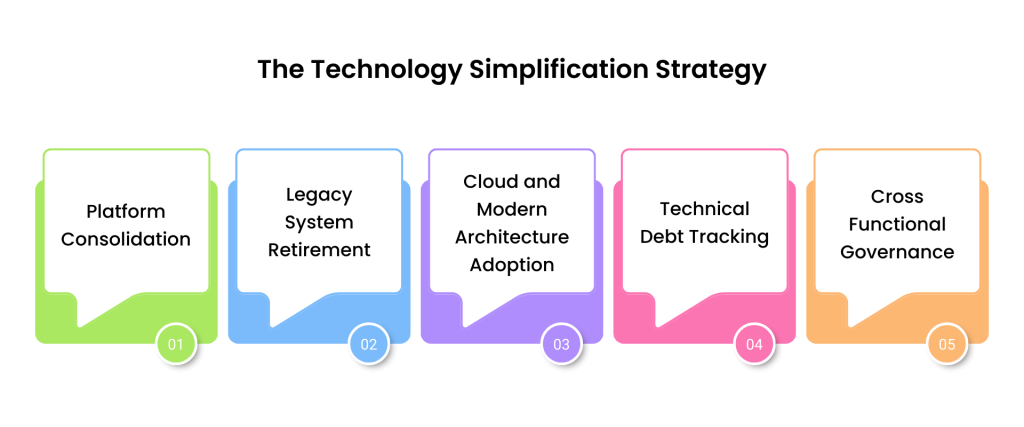
Key principles include:
1. Platform Consolidation
Reducing the number of overlapping tools and platforms across departments can significantly lower licensing and integration costs.
2. Legacy System Retirement
Gradually phasing out outdated systems reduces maintenance overhead and security risks.
3. Cloud and Modern Architecture Adoption
Migrating toward scalable, modular architectures enables faster innovation and lower operational complexity.
4. Technical Debt Tracking
Organizations should measure and track technology debt as part of financial planning, similar to capital investments or operational expenditures.
5. Cross-Functional Governance
Technology decisions should involve both IT and business leadership to ensure alignment between technological capability and business value.
Simplification is not just about reducing systems—it is about designing a technology ecosystem that supports agility, resilience, and long-term growth.
Conclusion
Technology debt accumulates quietly, but its financial consequences can be profound.
It drives maintenance cost spirals, slows innovation, leaks budgets across fragmented platforms, and increases operational risk. Left unmanaged, it gradually erodes an organization’s ability to compete in an increasingly digital marketplace.
For modern enterprises, addressing technology debt is not just an IT initiative—it is a strategic financial decision.
Organizations that proactively simplify their technology ecosystems, modernize their infrastructure, and align technology investments with business strategy will not only reduce costs but also unlock faster innovation and stronger resilience.
Because ultimately, technology debt is not just a technical problem.
It is a financial one.