In today’s digital enterprise, technology environments are expanding faster than organizations can effectively manage them. Over the past decade, companies have rapidly adopted cloud platforms, SaaS applications, automation tools, security solutions, analytics engines, and AI-driven technologies. While each of these systems may solve a specific business need, the cumulative result is often an overly complex technology ecosystem.
Instead of improving agility, excessive complexity can increase operational risk, reduce visibility, and slow down innovation. Many organizations now operate hundreds of interconnected systems, making governance, security, and operational efficiency difficult to maintain.
This is where Enterprise Simplification Strategy becomes critical. Simplification does not mean removing technology or slowing modernization. Instead, it focuses on aligning systems, processes, and governance to reduce complexity while maintaining business continuity.
A well-designed simplification strategy allows organizations to reduce risk, improve efficiency, and modernize infrastructure without disrupting operations.
Why Enterprise Complexity Has Become a Strategic Risk?
Most enterprises did not intentionally design complex technology environments. Complexity usually emerges gradually due to:
- Rapid digital transformation initiatives
- Department-level tool adoption without centralized governance
- Mergers and acquisitions introducing redundant platforms
- Legacy systems that remain integrated with modern solutions
- Overlapping security and monitoring tools
Over time, this creates technology sprawl — a condition where multiple systems perform similar functions, integrations multiply, and operational oversight becomes fragmented.
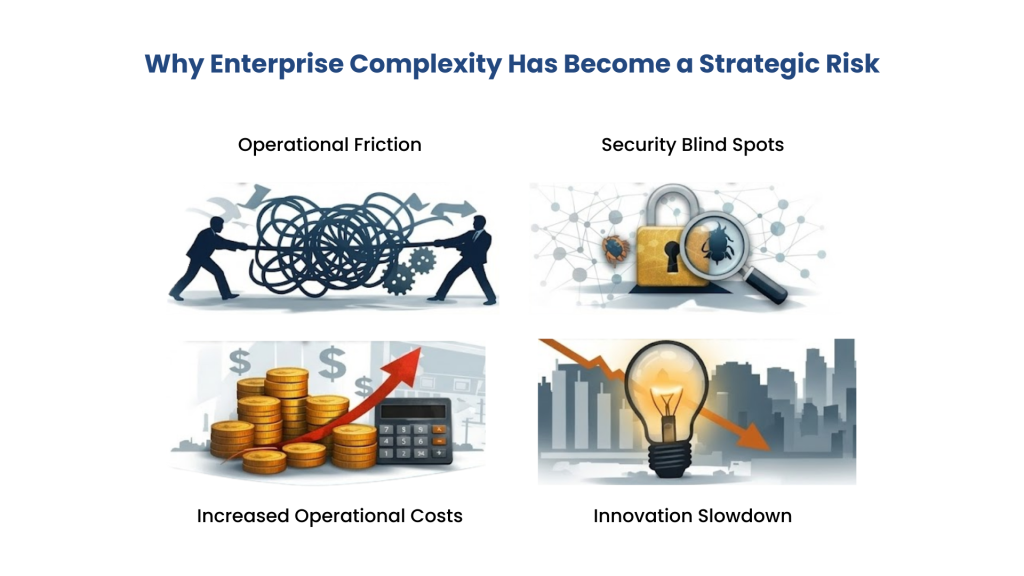
The consequences are significant:
Operational friction
Teams spend more time managing integrations and troubleshooting system conflicts than delivering value.
Security blind spots
When tools and environments multiply, it becomes harder to maintain full visibility into vulnerabilities and threat exposure.
Increased operational costs
Maintenance, licensing, infrastructure management, and integration support costs rise dramatically.
Innovation slowdown
Complex architectures slow development cycles and make implementing new technologies more difficult.
A simplification strategy helps organizations restore alignment between technology and business objectives.
Assessment Methodology: Understanding the Complexity Landscape
The first step in enterprise simplification is a comprehensive assessment of the current technology environment.
Without a clear understanding of system dependencies, data flows, and operational roles, simplification initiatives can introduce disruption rather than reduce risk.
A structured assessment typically evaluates the following dimensions:
System Inventory
Organizations must create a complete inventory of all technology assets, including:
- Applications and software platforms
- Infrastructure systems
- Cloud services
- Security tools
- Data platforms and integrations
This inventory helps identify duplicate systems, unused tools, and overlapping capabilities.
Dependency Mapping
Modern enterprise systems rarely operate independently. A single application may rely on dozens of integrations across multiple environments.
Dependency mapping helps organizations understand:
- How systems interact
- Where critical operational dependencies exist
- Which integrations create risk exposure
Operational Ownership Analysis
Many organizations struggle with unclear system ownership. When multiple teams share responsibility for the same tools, accountability becomes blurred.
Simplification assessments should clarify:
- Who owns each system
- Who maintains it
- Who depends on it for operations
Risk Exposure Evaluation
Complex systems create risk in multiple areas:
- Security vulnerabilities
- Compliance gaps
- Operational failure points
- Data integrity risks
Understanding where complexity introduces risk allows organizations to prioritize simplification efforts strategically.
System Consolidation Roadmap
Once the assessment phase is complete, organizations can begin designing a system consolidation roadmap.
The objective is not simply to remove systems but to optimize the architecture so that each system serves a clear and necessary purpose.
Key consolidation strategies include:
Eliminating Redundant Systems
In many organizations, multiple platforms perform the same functions.
For example:
- Several monitoring tools
- Multiple data analytics platforms
- Duplicate collaboration systems
Consolidation reduces licensing costs and simplifies operational management.
Standardizing Core Platforms
Organizations benefit from standardizing technology platforms across departments.
Standardization enables:
- Better integration
- Easier training and onboarding
- Improved governance
- Simplified security management
Rationalizing Legacy Systems
Legacy systems often remain active because critical processes depend on them.
Instead of abrupt removal, organizations should identify:
- Which legacy systems must remain temporarily
- Which can be modernized
- Which can be safely retired
This approach avoids operational disruption while reducing long-term complexity.
Risk Mapping: Identifying Complexity-Driven Vulnerabilities
Not all complexity introduces the same level of risk. Some systems may be complicated but stable, while others create serious vulnerabilities.
Risk mapping helps organizations identify which areas require immediate simplification.
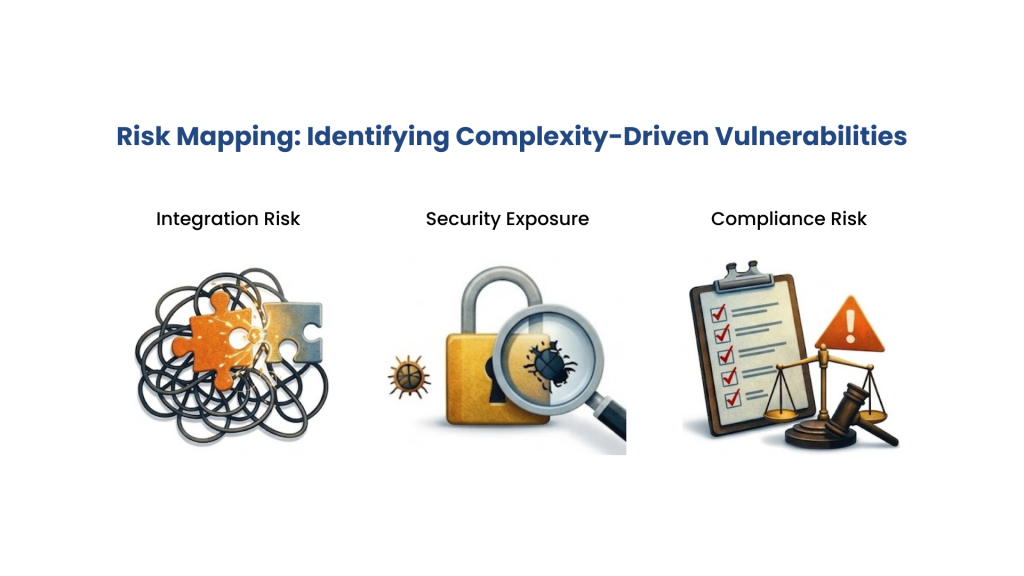
Important risk factors include:
Integration Risk
Highly interconnected systems increase the chance that failures will cascade across platforms.
Simplification efforts should prioritize high-dependency integration points.
Security Exposure
Each additional system expands the potential attack surface.
Simplification reduces:
- Unmonitored endpoints
- Shadow IT systems
- Authentication inconsistencies
Compliance Risk
Regulated industries often face challenges maintaining compliance across fragmented systems.
Simplification improves:
- Data governance
- Audit transparency
- Policy enforcement
By linking complexity directly to risk exposure, leadership can make data-driven simplification decisions.
Phased Modernization: Simplification Without Disruption
One of the biggest concerns organizations have about simplification initiatives is operational disruption.
Replacing or consolidating systems can affect workflows, employees, and customers if not executed carefully.
A phased modernization approach helps minimize disruption.
Phase 1: Visibility and Alignment
- Complete system assessment
- Establish governance structure
- Identify high-risk complexity areas
Phase 2: Low-Risk Consolidation
- Remove unused or redundant systems
- Simplify low-dependency integrations
- Standardize tools across teams
Phase 3: Core Platform Optimization
- Modernize critical infrastructure
- Improve integration architecture
- Implement unified monitoring and security
Phase 4: Strategic Transformation
- Replace high-risk legacy platforms
- Introduce modern, scalable architecture
- Align systems with long-term business strategy
This phased approach ensures that simplification strengthens operations rather than disrupting them.
ROI-Based Prioritization
Simplification initiatives must demonstrate measurable business value. Organizations should prioritize projects based on return on investment (ROI).
ROI evaluation should consider both financial and operational benefits.
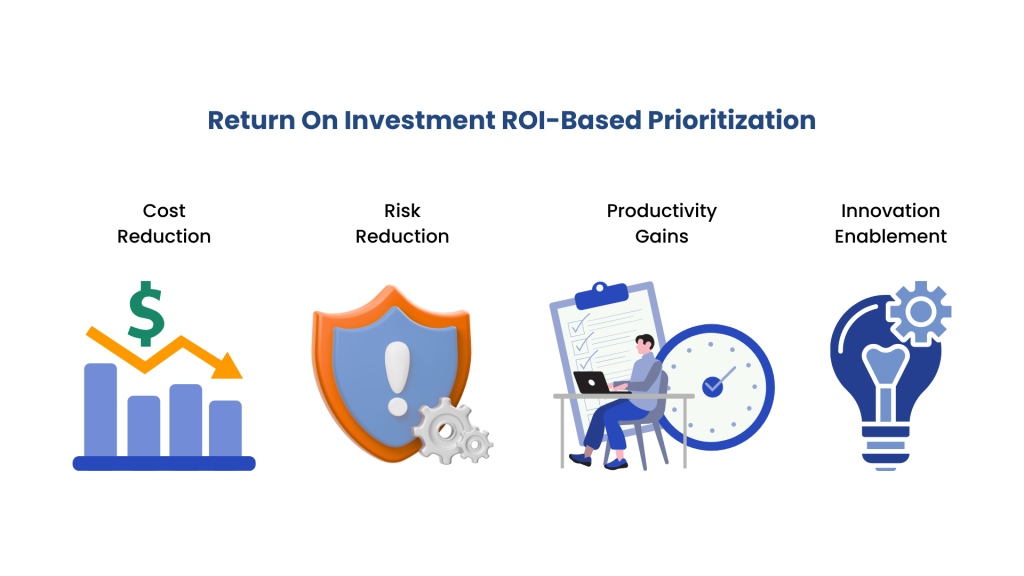
Cost Reduction
Simplification reduces:
- Licensing fees
- Infrastructure maintenance costs
- Integration management expenses
- Vendor management overhead
Risk Reduction
Reducing complexity decreases:
- Security incident likelihood
- Compliance penalties
- Operational outages
Productivity Gains
Simpler environments enable teams to work more efficiently by:
- Reducing system friction
- Improving data accessibility
- Streamlining workflows
Innovation Enablement
Simplified architectures make it easier to:
- Deploy new technologies
- Implement automation
- Scale digital services
By linking simplification efforts to measurable outcomes, organizations ensure executive alignment and long-term support.
Building a Culture of Strategic Simplicity
Technology simplification is not a one-time project. It must become an ongoing operational discipline.
Organizations should establish governance models that continuously monitor and control complexity growth.
Best practices include:
- Technology approval frameworks
- Centralized architecture governance
- Integration standards
- Regular complexity audits
- Clear system ownership
When simplification becomes part of the enterprise operating model, organizations can maintain agility without sacrificing control.
Conclusion
In modern enterprises, complexity has become one of the most underestimated sources of operational risk.
Organizations often believe that adding more technology will improve capabilities. In reality, misaligned systems create friction, reduce visibility, and increase vulnerability.
An effective Enterprise Simplification Strategy helps organizations regain control of their technology environment by:
- Assessing complexity systematically
- Consolidating redundant systems
- Mapping and reducing risk exposure
- Modernizing infrastructure in phases
- Prioritizing initiatives based on measurable ROI
The result is a technology ecosystem that is aligned, resilient, and capable of supporting long-term innovation.
Because ultimately, the strongest enterprises are not the most technologically advanced — they are the most strategically aligned.