
Introduction: The Illusion of Control
AI is often perceived as a controllable extension of enterprise technology. In reality, it behaves very differently.
Unlike traditional systems, AI:
- Evolves over time
- Depends on external data and models
- Produces probabilistic—not deterministic—outcomes
This creates an illusion of control.
At the surface, everything appears functional. Beneath it, risks accumulate silently—until they manifest at scale.
For boards, this changes the mandate:
AI is not just something to approve. It is something to continuously question.
1. Regulatory Exposure: From Compliance to Accountability
Most organizations approach regulation as a checklist. With AI, that approach breaks down.
Why?
Because regulators are increasingly focused on:
- Intent (Why was AI used?)
- Impact (Who was affected?)
- Explainability (Can decisions be justified?)
This shifts the burden from compliance to accountability.
Board-Level Insight:
Regulatory risk in AI is not just about violating rules—it’s about failing to demonstrate responsible decision-making under scrutiny.
What Boards Should Challenge:
- Can we explain how critical AI decisions are made—not just what they produce?
- Are we prepared for retrospective audits of AI-driven outcomes?
- Do we have documentation that stands up to regulatory investigation?
2. Digital Footprint Expansion: Complexity Without Visibility
AI doesn’t just add systems—it creates interdependencies.
Data flows across:
- Internal platforms
- External APIs
- Cloud environments
- Third-party ecosystems
This creates a non-linear expansion of risk.
Board-Level Insight:
The biggest AI risk is not the technology itself—but the loss of visibility across interconnected systems.
Key Questions:
- Where does our AI system actually operate beyond our core infrastructure?
- Which parts of our AI stack are outside direct control?
- Are we securing the connections, not just the systems?
3. AI Supply Chain Risk: The Black Box Problem
Enterprises are increasingly relying on pre-trained models, external datasets, and vendor-driven AI services.
This introduces a critical issue:
You are accountable for outcomes you don’t fully control.
Board-Level Insight:
AI supply chain risk is not just vendor risk—it is decision risk outsourced to opaque systems.
What Boards Should Ask:
- Do we understand how third-party models are trained and validated?
- Are we exposed to risks embedded within external datasets?
- What level of transparency do we require from AI vendors?
4. Executive Oversight: The Ownership Gap
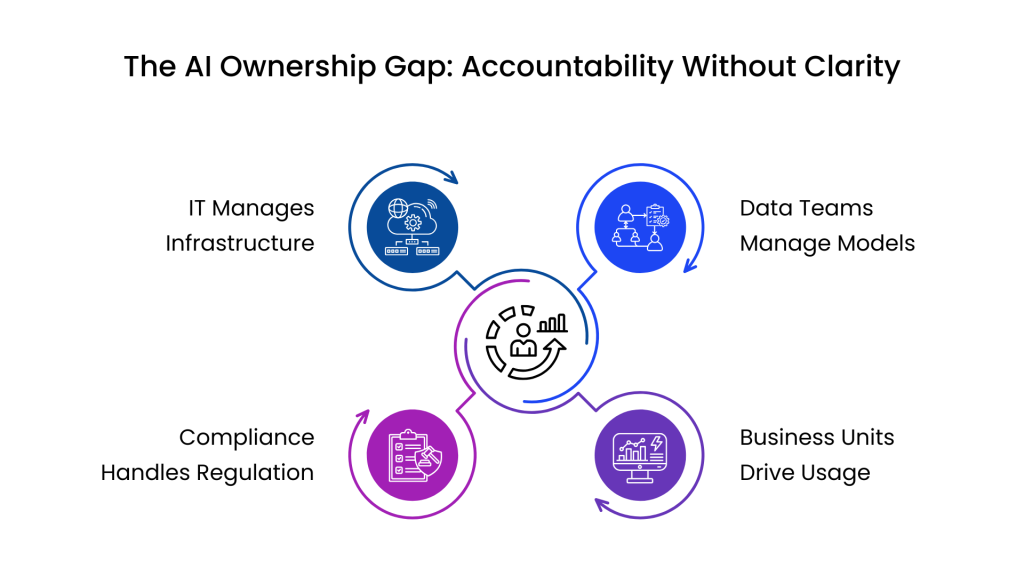
In many organizations, AI responsibility is fragmented:
- IT manages infrastructure
- Data teams manage models
- Compliance handles regulation
- Business units drive usage
The result?
No single point of accountability.
Board-Level Insight:
If AI risk is everyone’s responsibility, it becomes no one’s accountability.
Critical Governance Questions:
- Who is ultimately accountable for AI-driven decisions?
- Is AI risk reported with the same rigor as financial or cybersecurity risk?
- Does the board receive structured, periodic AI risk updates?
5. Strategic Controls: Moving Beyond Reactive Governance
Many organizations still apply controls after deployment—when issues are already visible.
But AI risks emerge:
- During data collection
- During model training
- During real-world usage
Board-Level Insight:
In AI, risk prevention is exponentially more effective than risk correction.
Strategic Shift Required:
- Embed controls at every stage of the AI lifecycle
- Treat model validation as ongoing—not one-time
- Align AI risk controls with enterprise risk frameworks
6. Data Governance: The Silent Risk Multiplier
Data is often treated as a technical asset. In AI, it becomes a strategic risk driver.
Poor data doesn’t just create errors—it scales those errors automatically.
Board-Level Insight:
AI doesn’t create new problems—it amplifies existing ones, especially in data.
Key Questions:
- Are we confident in the integrity of the data feeding our AI systems?
- Can we trace how data influences specific decisions?
- Are we managing data bias proactively—or reacting to outcomes?
7. Ethical and Reputational Risk: Speed vs. Trust
AI enables faster decisions—but not always better ones.
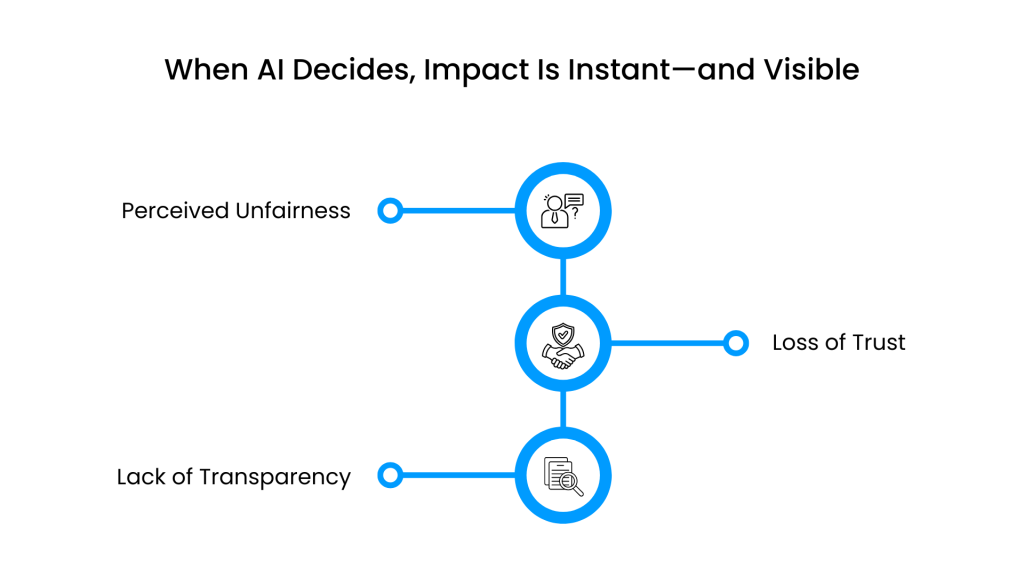
When AI decisions impact customers or stakeholders, the consequences are immediate:
- Perceived unfairness
- Lack of transparency
- Loss of trust
Board-Level Insight:
In AI, reputational risk moves faster than operational risk.
What Boards Should Evaluate:
- Are we prioritizing speed over fairness?
- Do we have clear ethical boundaries for AI usage?
- How quickly can we respond to public concerns around AI decisions?
8. Model Drift and Decision Degradation: The Slow Failure
Unlike traditional systems, AI models degrade over time.
Changes in behavior, data, or context can lead to:
- Reduced accuracy
- Biased outcomes
- Misaligned decisions
Often, this happens gradually—and goes unnoticed.
Board-Level Insight:
The most dangerous AI failures are not sudden—they are silent.
Questions to Consider:
- How do we detect performance drift early?
- Do we have thresholds for acceptable degradation?
- Are models continuously retrained and validated?
9. Resilience: When AI Becomes a Single Point of Failure
As AI becomes embedded in critical operations, dependency increases.
Without fallback mechanisms, failure can cascade across systems.
Board-Level Insight:
AI should enhance resilience—not become a dependency risk.
Key Considerations:
- Do we have human override mechanisms?
- Can critical processes function without AI?
- Is AI included in disaster recovery and continuity planning?
10. Strategic Alignment: Are We Scaling Risk or Value?
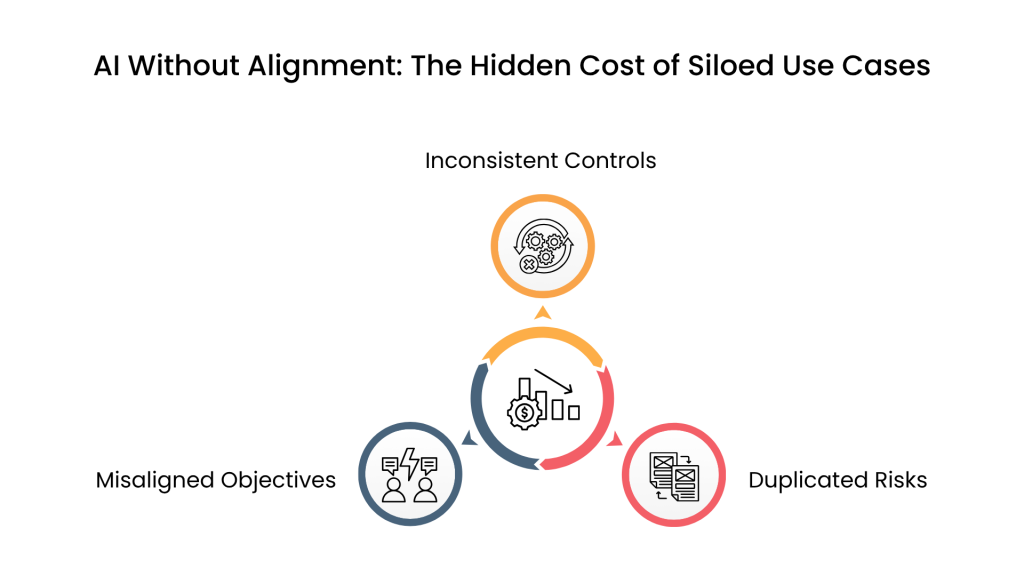
AI is often adopted in isolated use cases—without a unified strategy.
This leads to:
- Inconsistent controls
- Duplicated risks
- Misaligned objectives
Board-Level Insight:
Uncoordinated AI adoption scales complexity faster than value.
What Boards Should Ensure:
- Alignment between AI initiatives and business strategy
- Centralized visibility across all AI deployments
- Consistency in governance and risk management
Conclusion: From Innovation Pressure to Governance Discipline
AI is not inherently risky—but unmanaged AI is.
Boards that treat AI as purely an innovation agenda risk overlooking its systemic impact.
The real shift is this:
From asking “How fast can we adopt AI?”
To asking “How well can we control it at scale?”
Because in enterprise environments:
Control is not the opposite of innovation.
It is what makes innovation sustainable.