
Introduction: The Enterprise Edge Has Redefined Control
Enterprise environments have undergone a fundamental shift. What was once a clearly defined and centrally managed infrastructure has evolved into a distributed ecosystem where access happens across locations, devices, and platforms.
Today, employees, partners, and third parties interact with enterprise systems using a combination of corporate-managed devices, personal endpoints, and cloud-based applications. This has significantly increased flexibility and productivity—but it has also expanded the points of exposure.
Endpoints are no longer passive access tools. They actively participate in:
• Authentication and identity verification
• Data access and transfer
• Execution of business-critical workflows
This creates a structural imbalance:
access has scaled rapidly, but control mechanisms have not evolved at the same pace.
Endpoint exposure arises when organizations lack consistent:
• Visibility into devices and access activity
• Enforcement of security policies across environments
• Monitoring of how access is being used in real time
Importantly, endpoint exposure is not a single weakness—it is the result of multiple small gaps combining into a larger risk surface.
Understanding the Financial Impact of Endpoint Breaches
The financial consequences of endpoint-related incidents are often underestimated because they extend beyond immediate response costs. In reality, the impact unfolds across multiple layers.
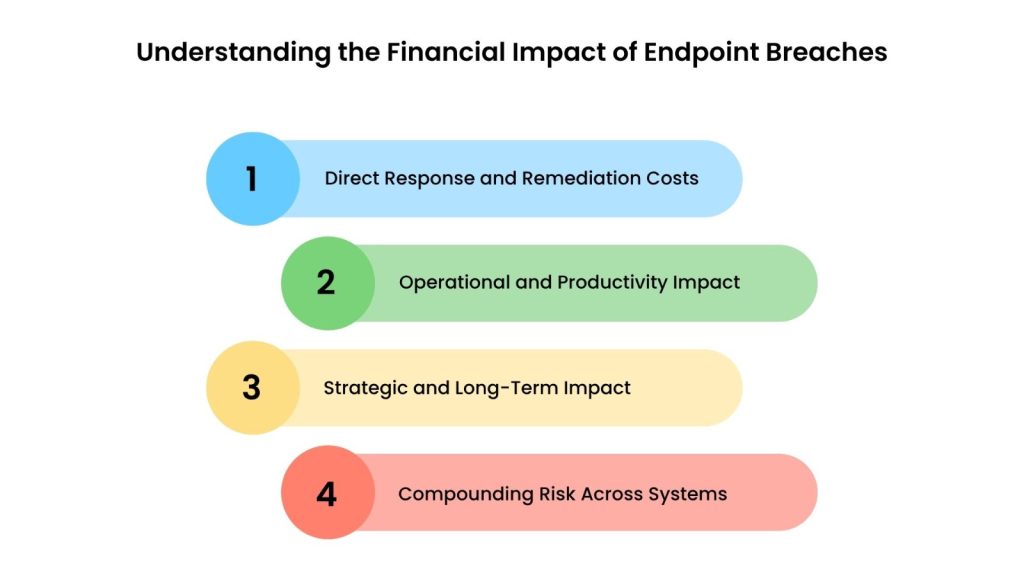
1. Direct Response and Remediation Costs
These are the most visible and immediate expenses:
• Incident detection, investigation, and forensic analysis
• Containment actions such as isolating affected endpoints
• Reimaging systems and restoring operational integrity
• Legal consultations and regulatory reporting obligations
While these costs are measurable, they represent only the initial phase of impact.
2. Operational and Productivity Impact
Endpoint incidents frequently disrupt normal business operations:
• Employees may lose access to critical systems
• Business processes slow down or temporarily stop
• IT teams shift focus from planned initiatives to incident response
Even short disruptions can affect service delivery, internal coordination, and customer-facing operations.
3. Strategic and Long-Term Impact
Longer-term effects are often less visible but more significant:
• Erosion of customer and partner trust
• Increased scrutiny from regulators or stakeholders
• Additional investments required to strengthen security posture
In competitive environments, repeated disruptions or perceived weaknesses in security can influence business outcomes over time.
4. Compounding Risk Across Systems
Endpoint incidents rarely remain isolated.
Due to interconnected systems, a single compromised endpoint can:
• Provide access to additional systems or accounts
• Enable movement across environments
• Increase the scope and cost of response efforts
This compounding effect is why early detection and containment are critical.
Credential Compromise: A Primary Driver of Endpoint Risk
A large proportion of modern incidents involve the misuse of valid credentials rather than direct exploitation of technical vulnerabilities.
Endpoints play a central role because they are where:
• Users authenticate
• Credentials are entered, stored, or cached
• Sessions are established and maintained
How Credentials Become Exposed?
Common pathways include:
• Phishing attacks that capture login information through deceptive interfaces
• Malware or infostealers that extract stored credentials or session tokens
• Browser-based attacks targeting cookies and active sessions
• Unsecured network usage where data can be intercepted without proper safeguards
Why Credential Misuse Is Hard to Detect?
When attackers use valid credentials:
• Access appears legitimate at the system level
• Traditional security alerts may not trigger immediately
• Detection depends on identifying subtle behavioral anomalies
This creates a shift in security focus:
from blocking unauthorized access → to validating legitimate access continuously.
Operational Disruption: When Endpoint Risk Becomes Business Disruption
Endpoint compromise often translates into operational impact, especially in environments where systems are interconnected.
Direct Disruptions
• Systems may be taken offline to contain potential threats
• Access may be restricted while investigations are conducted
• Data integrity may need to be verified or restored
Indirect Organizational Impact
• IT and security teams move into reactive mode
• Business units experience delays and reduced efficiency
• Cross-functional coordination increases, affecting productivity
Why This Matters?
The disruption is often not caused solely by the incident itself, but by:
• The time required to assess the situation
• The effort needed to contain potential spread
• The complexity of restoring normal operations safely
This is why preparedness and response capability are as important as prevention.
Limitations of Traditional Endpoint Security Approaches
Traditional endpoint security strategies were designed for environments with:
• Fixed office-based workforces
• Centrally managed and trusted networks
• Clearly defined perimeters
Modern enterprise environments no longer operate within these constraints.
Current Reality
• Users access systems from multiple locations
• Devices connect through external or untrusted networks
• Applications are distributed across cloud and hybrid platforms
Key Limitations of Legacy Approaches
• Device-centric trust models that assume a secure device equals secure access
• Limited visibility into user behavior after authentication
• Static controls that do not adapt to changing risk conditions
These limitations make it difficult to accurately assess and manage risk in real time.
Evolving the Approach: Identity, Context, and Behavior
To address endpoint exposure effectively, organizations are adopting a more comprehensive control model.
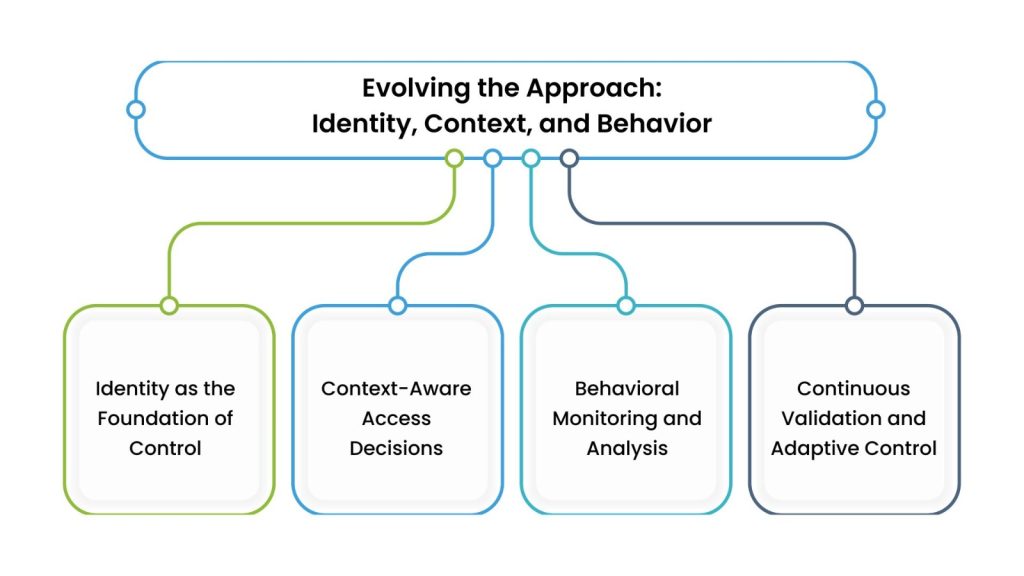
1. Identity as the Foundation of Control
• Multi-factor authentication (MFA) to strengthen access validation
• Robust identity and access management practices
• Enforcement of least-privilege access principles
2. Context-Aware Access Decisions
Access is evaluated based on additional factors such as:
• Device health and compliance status
• User location and network conditions
• Time, frequency, and patterns of access
3. Behavioral Monitoring and Analysis
• Identifying deviations from established user behavior
• Detecting unusual access patterns or data movement
• Supporting earlier identification of potential misuse
4. Continuous Validation and Adaptive Control
• Access is assessed throughout the session—not just at login
• Risk signals can trigger additional verification steps
• Sessions can be restricted or terminated when necessary
This approach aligns with modern security frameworks that emphasize continuous verification over implicit trust.
Executive Accountability: A Business-Level Responsibility
Endpoint exposure is no longer confined to technical teams—it has direct implications for business performance.
Why Leadership Must Be Involved?
• Financial and operational risks extend beyond IT functions
• Regulatory expectations increasingly require oversight
• Security posture influences customer and partner confidence
Key Leadership Priorities
• Visibility: Do we have a clear understanding of all endpoints and access points?
• Control: Are policies consistently enforced across environments?
• Measurement: Are we tracking meaningful indicators of risk and response?
• Alignment: Is security integrated into broader business strategy?
Leadership involvement ensures that endpoint risk is addressed proactively rather than reactively.
Building a Practical and Resilient Endpoint Strategy
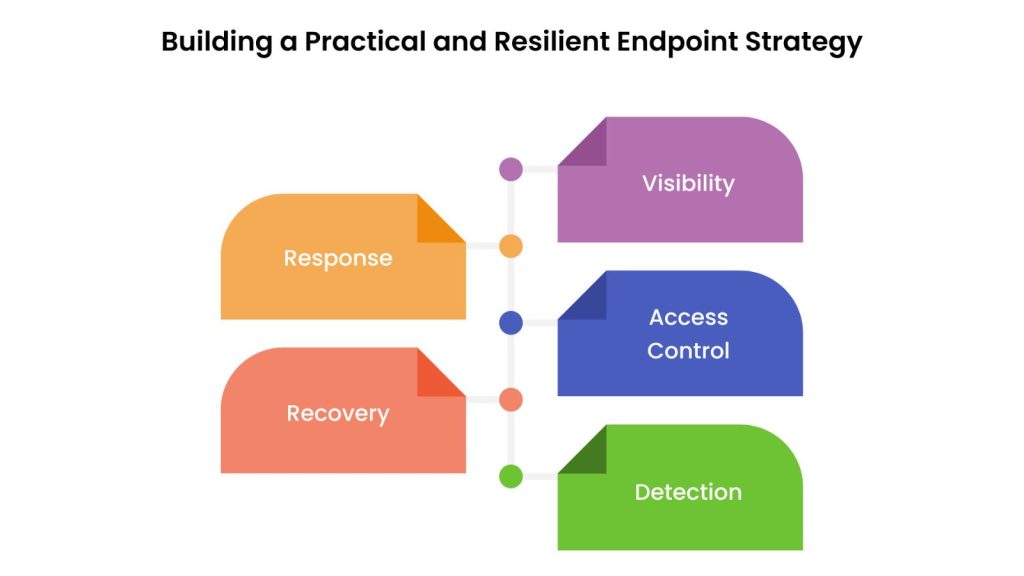
A balanced and effective strategy includes:
1. Visibility
• Continuous discovery and inventory of endpoints
• Monitoring both managed and unmanaged devices
2. Access Control
• Enforcing least-privilege principles
• Restricting unauthorized applications and connections
3. Detection
• Behavioral analytics to identify anomalies
• Integration with centralized monitoring systems
4. Response
• Rapid isolation of potentially compromised endpoints
• Immediate credential reset and session termination
5. Recovery
• Efficient restoration of systems and data
• Business continuity planning to minimize disruption
The objective is not to eliminate all incidents—
but to reduce their impact, contain them quickly, and recover efficiently.
Conclusion: Control at the Edge Defines Risk Exposure
As enterprise environments continue to expand, the edge becomes a critical point of both access and risk.
Organizations that lack visibility and control over endpoints may face:
• Increased exposure to credential misuse
• Operational inefficiencies during incidents
• Difficulty maintaining a consistent security posture
Those that strengthen control—through identity, context, and continuous monitoring—are better positioned to manage risk while enabling business operations.
In modern environments, control is not about restricting access—
it is about understanding and managing how access is used.